Choose Science

 “If you want to save your child from polio, you can pray or you can inoculate.  Choose science.”  — Carl Sagan, The Demon-Haunted World

Far be it for me to provide scientific illiterates like Donald Trump and Robert F. Kennedy, Jr. with an appreciation of vaccine science.  For them and their admirers, political commitments preclude an understanding of the human immune system, how vaccines work, and how scientists go about creating them and demonstrating their safety and efficacy.  So let’s take a different approach.  Let’s try to cultivate an appreciation of vaccine science that is strictly historical and begins with the Revolutionary War.  In this way, perhaps, vaccine skeptics can edge toward an appreciation of the foundational role of vaccination and its precursor, inoculation, to American greatness in the pre-Trump era.

_____________________

Dear Anti-Vaxxers:

Did you know that at the outset of the Revolutionary War,  inoculation against smallpox – the insertion of  pus from the scabs and pustules of smallpox sufferers into arms of healthy soldiers to induce typically mild attacks of smallpox – was a crucial instrument of strategic advantage for British and Continental forces alike?  When inoculated British troops came into contact with healthy Continental soldiers and noncombatants, that is, the latter frequently contracted smallpox in its unattenuated, occasionally lethal form.  The only defense against disablement-by-smallpox, it turned out, was inoculation, since inoculated soldiers and civilians, after recovery, were immunized against smallpox in both its deadly and attenuated forms.

Did you know that when George Washington realized that overcoming smallpox was crucial to winning the War of  Independence, he indeed mandated the inoculation of the entire Continental Army?   His order of 5 February 1777 also sent a clear message to all 13 colonies:  American governments – local, state, and national – were obligated to “protect public health by providing broad access to inoculation.”[1]

Did you know that when Benjamin Waterhouse began shipping  Edward Jenner’s smallpox vaccine to America in 1800, George Washington, John Adams, and Thomas Jefferson hailed it as the greatest discovery of modern medicine?  When Jefferson became president in 1801, he pledged to introduce the vaccine to the American public because “it will be a great service indeed rendered to human nature to strike off the catalogue of its evils so great a one as the smallpox.”

Did you know that Jefferson’s successor, James Madison, signed into law in 1813 “An Act to Encourage Vaccination”?  And did you know that among its provisions was the requirement that the U.S. postal service “carry mail containing vaccine materials free of charge.[2]

Did you know that during the Civil War, Union and Confederate Armies were so desperate to vaccinate their troops against smallpox that they had their doctors cooperate in harvesting “vaccine matter” from the lymph of heathy children and infants, especially the offspring of the formerly enslaved?[3]

Did you know that when the Civil War ended, doctors from North and South joined forces to achieve a better understanding of smallpox vaccination methods?[4]  They believed an epidemiological understanding of effective vaccination was a shared mission in the service of the re-united nation.

Did you know that in 1893 New York State legislators passed a law requiring public schools to deny enrollment to any child who could not present proof of vaccination, and that the law was extended to private and parochial schools via the Jones-Tallett amendment of 1915?[5]  And did you know that the legislators’ commitment to vaccination for all children was reaffirmed a half century later, when Title XIX of the Social Security Act of 1965 mandated “the right of every American child to receive comprehensive pediatric care, including vaccinations.”[6]
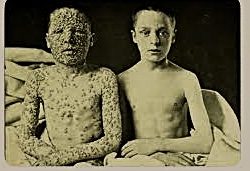
Two 13-year-old classmates exposed to the same strain of smallpox at the same time in their classroom in Leicester, England in 1901. One was vaccinated against smallpox in infancy. The other was not.

Did you know that throughout the 19th century, diphtheria was “the dreaded killer that stalked young children”?[7]   It was an  upper-respiratory inflammation of such severity that it gave rise to a  “pseudomembrane” that covered the pharynx and larynx and led to death by  asphyxiation.    Then, in the early 1890s, Emile Roux and his team at the Pasteur Institute discovered that horses not only withstood repeated inoculation with live diphtheria bacteria, but their blood, purified into an injectable serum, both restored infected children (and adults) to health and provided healthy kids with short-term immunity.  No sooner did the serum become commercially available in 1895 than the U.S. death rate among hospitalized diphtheria patients was cut in half  – an astonishing fact for the time.  By 1913, when the “Shick test” permitted on-the-spot testing for diphtheria, public health nurses and doctors discovered that 30% of NYC school children tested positive for the disease.  Injections of serum saved the vast majority and immunized their healthy classmates.  New York’s program of diphtheria immunization was copied by municipalities throughout the country. In the early 1930s, diphtheria serum gave way to a long-lasting toxoid vaccine, and in the 1940s, given in combination with pertussis and tetanus vaccines (DBT), diphtheria, “the plague among children” (Noah Webster), became a horror of the past.

A ghostly Skeleton, representing diphtheria, reaches out to strangle a sick child. Watercolor by Richard Tennant Cooper (1885–1957), commissioned by Henry S. Wellcome c. 1912 and now in the Wellcome Collection

Did you know that in Jacobson v. Massachusetts, a landmark decision of 1905, the U.S. Supreme Court affirmed the constitutionality of compulsory vaccination laws? And then, in 1922, in Zucht v. King, the Court stated that “no constitutional right was infringed by excluding unvaccinated children from school.”  The decision was written by Louis Brandeis.[8]

Did you know that in 1909 the U.S. Army made typhoid vaccination compulsory for all soldiers, and the requirement reduced the typhoid rate among troops from 243 per 100,000 in 1909 to 4.4 per 100,000 in three years?[9]  When America entered WWI in 1917, troops sailing to France had to be vaccinated.  Those who had not received their shots stateside received them on arriving at their camps.  Vaccination was not negotiable.  The obligation to live and fight for the nation trumped the freedom to contract typhoid, suffer, and possibly die.

Did you know that in the mid-1950s, when Cold War tensions peaked, mass polio vaccination was such a global imperative that it brought together the United States and Soviet Union?   In 1956, with the KGB in tow, two leading Russian virologists journeyed to Albert Sabin’s laboratory in Cincinnati Children’s Hospital, while Sabin in turn flew to Moscow to continue the brainstorming.  The short-term result was mass trials that confirmed with finality the safety and efficacy of the Sabin vaccine, while bringing its benefits to 10 million Russian school children and several million young Russian adults.[10]  The long-term result was the Global Polio Eradication Initiative that began in 1988 and eradicated polio transmission everywhere in the world except Afghanistan and Pakistan.

Did you know that following the development of a freeze-dried smallpox vaccine by Soviet scientists in 1958, Soviet Deputy Health Minister Viktor  Zhdanov and American public health epidemiologist Donald Henderson jointly waged a 10-year international campaign to raise enough money to make the vaccine available world-wide?[11]  The result of their campaign, in partnership with WHO, was the elimination of smallpox by 1977.[12]

Did you know that in 1963 a severe outbreak of rubella (German measles) led the U.S. Congress to approve the “Early and Periodic Screening, Diagnosis, and Treatment” amendments to Title XIX of the Social Security Act of 1965?  The amendments mandated the right of every American child to comprehensive pediatric care, including vaccinations.[13]

___________________

Now, in 2025, a segment of the population has reclaimed the mindset of antebellum America, when the Founding Fathers’ belief that medical progress safeguarded democracy gave way to something far less enlightened: the belief that everyone can be his or her own doctor.  Sadly, what the historian Joseph Kett termed the Dark Age of American medicine[14] has been revived among those newly skeptical of vaccination, and especially resistant to compulsory vaccination of children.  In its place, they proffer a contemporary variant of the anti-elitist cry of the Jacksonian era:  Every man his own doctor; every man his own remedies.  Transposed to the early 20th century, the Jacksonian cry resurfaced as resistance to smallpox vaccination.  To the anti-vaxxers of the time, the vaccine that, in its inoculatory form, helped win the Revolutionary War, was state-sanctioned trespassing on a person’s body.[15]  Now, in the wake of the coronavirus pandemic of 2020, the body has been politicized yet again.

In the case of President Donald Trump and Secretary of Health and Human Services Robert Kennedy, Jr., scientific ignorance of breathtaking proportions carries the prescientific regression back to ancient times.  When Plague, in the form of coronavirus, returned to America in 2020, legions of Trump followers followed the lead of a president whose understanding of viral infection followed the Galenic belief that whole-body states require whole-body remedies.  Disinfectants like Chlorox, he announced to the nation, kill microbes when we wipe our countertops with it.  Why then, he mused, can’t we destroy the coronavirus by injecting bleach into our veins?  What bleach does to healthy tissue, blood chemistry, and internal organs – these are questions an inquiring 8th grader might ask her teacher.  But they could not occur to a medieval physician or a boastfully ignorant President.  In Trump-world, as I observed elsewhere,[16] “there is no possibility of weighing the pros and cons of specific treatments for specific ailments (read: different types of infection, local and systemic).  The concept of immunological specificity is literally unthinkable.”  As to ingestion of hydroxychloroquine tablets, another touted Trump remedy for coronavirus, “More Deaths, No Benefit” begins the VA Virus Study reporting on Trump’s preferred Covid-19 treatment put forth by Trump.[17]

Trump’s HSS Secretary, Robert Kennedy, Jr. would not be among the inquiring 8th graders.  When coronavirus reached America, Trump at least followed a medieval script.  Kennedy Jr., encased in two decades of anti-vaccine claptrap, did not need a script. He simply absorbed coronavirus into an ongoing narrative of fabrication, misinformation, and bizarre conspiracy theories calculated to scare people away from vaccination.

As HHS Secretary, Kennedy Jr.’s mission has been to complexify access to coronavirus vaccines.  Most recently, he directed the CDC to rescind its recommendation of Covid-19 vaccination for pregnant women and healthy young children.  The triumph of scientists in creating safe genetic RNA vaccines could not dislodge the medieval mindset and paranoid delusions that have long been his stock in trade.  No, Mr. Secretary, Covid-19 was not engineered to attack Caucasians and African Americans while sparing Ashkenazi Jews and the Chinese.  No, Covid-19 vaccines were not created to effect governmental control via implanted microchips.  No, vaccines do not cause autism.  No, Wi-Fi is not linked to cancer.  No, anti-depressants do not lead to school shootings.  No, pharmaceutical firms are not conspiring to poison children to make money.

During the Black Death, 14th-century Flagellants roamed the streets of continental Europe, whipping themselves in a frenzy of self-mutilation that left them lacerated if not dead.  Their goal was to placate a wrathful God who had breathed down, literally, the poisonous vapors of Plague.  What they did, in fact, was leave behind an infectious stew of blood, tissue, and entrails that brought Plague to local villagers.   Kennedy, Jr. speaks out and showers listeners with verbal effluvia that induces them to forego vaccination and other scientifically grounded safeguards against disease.   Health-wise, he is a Flagellant,  spewing forth misinformation that puts listeners and their children at heightened risk for Covid-19 and  a cluster of infectious diseases long vanquished by vaccine science.

Does Kennedy, Jr. really believe that everything we have learned about the human immune system since the late 18th century is bogus, and that children who once died from smallpox, cholera, yellow fever, diphtheria, pertussis, typhoid, typhus, tetanus, and polio are still dying in droves, now from the vaccines they receive to protect them?   Does he believe the increase in life expectancy in the U.S. from 47 in 1900 to 77 in 2021 has nothing to do with vaccination?   Does he believe that the elimination of smallpox and polio from North America has nothing to do with vaccination?   Does he believe it a fluke of nature that the last yellow fever epidemic in America was in 1905, and that typhoid fever and diphtheria now victimize only unvaccinated American travelers who contract them abroad?

The fact that we have a President comfortably at home in the Galenic world, and an HSS Secretary whose web of delusional beliefs land him in the nether region of the Twilight Zone doesn’t mean the rest of us must follow suit.   We are citizens of the 21st century and entitled to reap the life-sustaining benefits of 250 years of sustained medical progress – progress that has taken us to the doorstep of epical advances in disease prevention, management, and cure wrought by genetic medicine.[18]   My urgent plea is carpe tuum tempus – seize the era in which you live.   Seize the knowledge that medical science has provided.  In a word:  Get all your vaccines and make doubly sure your children get theirs.  Do your part to Make America Sane Again.

______________________

[1] Andrew M. Wehrman, The Contagion of Liberty:  The Politics of Smallpox in the American Revolution.  Baltimore (Johns Hopkins Univ. Press, 2022), p. 220.

[2] Dan Liebowitz, “Smallpox Vaccination: An Early Start of Modern Medicine in America, ” J. Community Hosp. Intern. Med. Perspect., 7:61-63, 2017 (https://www.ncbi.nlm.nih.gov/pmc/articles/PMC5463674).

[3] Jim Downs, Maladies of Empire:  How Colonialism, Slavery, and War Transformed Medicine  (Cambridge:  Harvard Univ. Press,  2021), pp. 143-145.

[4] Ibid., p. 150.

[5] James Colgrove, Epidemic City: The Politics of Public Health in New York (NY:  Russell Sage Foundation, 2011), pp. 185-187.

[6] Louis Galambos, with Jane Eliot Sewell, Networks of Innovation:  Vaccine Development at Merck, Sharp & Dohme, and Mulford, 1895-1995 (Cambridge:  Cambridge Univ. Press, 1995), pp. 106-107.

[7] Judith Sealander, The Failed Century of the Child:  Governing America’s Young in the Twentieth Century (Cambridge: Cambridge Univ. Press, 2003), p. 326.

[8] Colgrove, op. cit., pp. 170, 190.

[9] Carol R. Byerly, Mosquito Warrior:  Yellow Fever, Public Health, and the Forgotten Career of General William C. Gorgas (Tuscaloosa: Univ. Alabama Press, 2024), p, 226.

[10] For elaboration, see Paul E. Stepansky, “Vaccinating Across Enemy Lines,”  Medicine, Health, & History, 16 April 2021 (https://adoseofhistory.com/2021/04/16/vaccinating-across-enemy-lines).

[12] Peter J. Hotez, “Vaccine Diplomacy:  Historical Perspective and Future Directions,” PLoS Neglected Trop. Dis. 8:e380810.1371, 2014; Peter J. Hotez, “Russian-United States Vaccine Science: Preserving the Legacy,” PLoS Neglected Trop. Dis., 11:e0005320,2017.

[13] Galombo & Sewell, op. cit., pp. 106-107.

[14] Joseph F. Kett, The Formation of the American Medical Profession:  The Role of Institutions, 1780-1860 (New Haven: Yale Univ. Press, 1968), p. vii.  I invoke the Jacksonian Dark Age of American medicine in  a different context in  Paul E. Stepansky, Psychoanalysis at the Margins (NY:  Other Press, 2009), pp. 283-285.

[15] Nadav Davidovitch, “Negotiating Dissent:  Homeopathy and Anti-Vaccinationism At the Turn of the Twentieth Century,” in Robert D. Johnston, ed., The Politics of Healing: Histories of Alternative Medicine in Twentieth-Century Medicine (New York:  Routledge, 2004), pp. 23-24.

[16] Paul E. Stepansky, “Covid-19 and Trump’s Medieval Turn of Mind,”  Medicine, Health, and History, 19 August 2020  (https://adoseofhistory.com/?s=Trump%27s+Medieval+turn)

[17]  Marilyn Marchone, “More deaths, no benefit from malaria drug in VA virus study,”  AP News, 21 April 2020 (https://apnews.com/article/malaria-donald-trump-us-news-ap-top-news-virus-outbreak-a5077c7227b8eb8b0dc23423c0bbe2b2).

[18] For a masterful introduction to the history of genetic medicine, including the discovery and applications of CRISPR gene editing, the development of RNA genetic vaccines for Covid-19, and the frontier of genetically engineered disease management, see Walter Issacson, Code Breaker:  Jennifer Doudna , Gene Editing, and the Future of the Human Race (NY:  Simon & Schuster, 2017).   No less illuminating is Doudna’s own account of her pathway to CRISPR research and evolving understanding of the therapeutic potential of CRISPR-based gene editing, Jennifer A. Doudna & Samuel H. Sternberg, A Crack in Creation:  Gene Editing and the Unthinkable Power to Control Evolution,  esp. chs. 1 & 2  (Boston:  Houghton Mifflin Harcourt, 2017).  Far more limited in scope but very worthwhile in illustrating contemporary genetic diagnosis and treatment is Am Amgis Ashley, The Genome Odyssey:   Medical Mysteries and the Incredible Quest to Solve Them (Milwaukee:  Porchlight, 2021).

Copyright © 2025 by Paul E. Stepansky. All rights reserved.  The author kindly requests that educators using his blog essays in their courses and seminars let him know via info[at]keynote-books.com.




Corporate Healthcare is Not Medicine: III. The Myth of “Patient Relations”

“The practice of medicine is an art, not a trade; a calling, not a business.”   William Osler

It began in the 1970s, the decade of human rights – the rights of minorities, of women, of pregnant women, of children, of the physically and mentally disabled.  Inevitably, the rights of medical patients came into focus, with New York’s Mt. Sinai Hospital leading the charge.  In 1967, it created the country’s first Patient Representative Department.  Five years later, in 1972, the American Hospital Association, drawing on a preliminary brief on patient rights prepared by the National Welfare Rights Organization, adopted a Patient Bill of Rights.  At decade’s end, in the service of such rights, Sarah Lawrence College established the first master’s degree program in health advocacy.[1]

Patient rights, embracing hospitals, managed care, HMOs, and group insurance plans, gained traction throughout the 1980s and 90s.  In 1990, Harold P. Freeman, a surgical oncologist at Harlem Hospital, introduced the notion of “patient navigation” in the hope of eliminating barriers to screening, diagnosis, and treatment of minority cancer patients.  Four years later, Nancy Davenport-Ennis founded the Patient Advocate Foundation; its mission was to provide case management services and financial assistance to Americans with debilitating and life-threatening illnesses.[2]  In1996, Congressional passage of the Health Insurance Portability and Accountability Act (HIPPA), with its emphasis on doctor-patient communication and the protection of sensitive patient information, shored up these private initiatives.

By century’s end, the medical landscape was filled with patient helpers:  patient advocates, patient experience specialists, patient navigators, healthcare educators, and, most recently, patient relations departments.  Summit Health, the product of the merger of Summit Medical Group and CityMD in 2019, established a patient relations department sometime after the merger.  Cigna Healthcare waited until February 3, 2025 to establish its patient relations department.  Well, better late than never.

Perhaps.  The very concept of “patient relations” is problematic for several reasons.  Notions of patient advocacy, navigation, and education have a strongly dyadic connotation:  the assumption is that a particular patient is in need of assistance, and that someone with the requisite knowledge is available to advocate for the patient, to help the  patient navigate a maze-like hospital or health plan environment and acquire information on how to proceed.  It may involve issues of evaluation, testing, and/or diagnosis, along with the pros and cons of different treatment plans.  According to the Journal of Patient Experience, some 70% of health care organizations now have a senior executive devoted to overseeing this cluster of patient advocacy services.[3]

Patient relations, on the other hand, is amorphous.  There is a patient, yes, but with whom or with what is the patient relating?  A physician?  An office staff?  The relations department itself?  Or perhaps the relation in question is with a  hospital, insurance company, or health plan in general.  Or perhaps none of the above.

In the case of my unhappy saga with the Summit Health Patient Relations Department  this past September, the answer is the final option:  none of the above.  I am a diabetic, and the saga began with the office staff of the endocrinologist who supplies my insulin.  Having barely avoided running out of insulin, and anxious to reestablish my regular three-month supply, I placed three phone calls, morning, afternoon, and closing time, to the provider’s office.  Each time, I indicated that I needed to speak with my physician that day about an important matter.  But I heard nothing – not from my physician, not from a medical colleague or member of the office staff, and not via the health plan’s patient portal.

The reason, it turned out, was because, unknown to me,  a “patient relations” staff member, responding to a complaint from a member of the office staff about the tone of my phone calls, advised the physician not to return my calls.  The patient relations staffer herself  would take care of the matter at hand.

But the promised contact never happened.  I only heard from the staffer by phone four days later.  She had tried to reach me sooner, she averred, but the office phone system was being upgraded and was apparently down at the time she placed the call.  The notion of trying again from a “live” phone apparently never occurred to her.  Withal, having finally contacted me by phone four days later, the human relations staffer listened to me, and then proceeded to the point of her call:  She informed me that concern had been expressed about my behavior (viz., my phone manner) in requesting a return call from my physician.  Absent so much as an allusion to the reason I sounded agitated, she added, gravely, that I may have acted inappropriately.

A call from the department manager a few days later was more conciliatory in nature.  She suggested there had been “miscommunication” on the part of the office staff, adding that the office staff required further training on how to respond to patients who called the office in a less than happy state of mind.  And she acknowledged as well that it would indeed be upsetting for an insulin-dependent diabetic to have barely avoided running out of  insulin and not reassured that his regular supply of a life-sustaining drug had been reestablished.

And then the pièce de resistance.   On September 26th, the morning after the department manager’s effort at conciliation, or at least shared responsibility, I received a letter dated September 20th from the “Summit Health Patient Relations Department,” absent any personal signatory.  The letter came from the patient relations staffer who had called me several days earlier on a disconnected phone line.   It began, “I have tried reaching out to you,” and then, flying in the face of her manager’s remarks the preceding evening, she became nakedly accusatory.  Now, simply because I had made three phone calls requesting a callback from my physician, and absent any relational exchange about the matter at hand, I stood guilty of behavior both “inappropriate” and “disruptive.”  The second paragraph reads:

Please know that as an employer, Summit Health has a responsibility to provide a safe and civil environment for our employees and providers.  We take this responsibility very seriously.  In the future we ask that you be courteous to all whom you encounter. Any further disruptive behavior could result in your discharge from this office.

The unsigned letter makes serious allegations that are unfounded and potentially libelous.  It threatens me with expulsion from the endocrinology office simply because I placed three phone calls to my physician’s office on September 18th, asking each time that the physician call me back about an important matter.  Apparently, in some preternatural way, three brief phone calls, during which I neither raised my voice nor used inappropriate language, impeded the work flow of the office.   The letter elides the particulars of the situation, skirting entirely the reciprocal obligation of physicians and  staff personnel to be responsive to patients, especially patients who reach out in times of  need.  I subsequently learned that the letter I received was in fact a template, and that equally impersonal  letters of rebuke had been sent to other Summit patients who, for one reason or another, elicited the disapproval of an office staff member.  All such letters were simply signed, “Summit Patient Relations Department.”

Taking the signatory of the letter at face value, I stand accused of “disruptive behavior” by a patient relations department that was uncomprehending of  relationality, especially the relationality that inheres in doctor-patient-office staff interactions.   Absent any relational engagement of  the particulars of  doctor-patient-staff interactions, what exactly is the raison d’être of a patient relations department?

_______________________

A broader issue that arose in my exchanges with the patient relations manager concerns the prerogative of a patient relations department to intrude into the doctor-patient relationship.  In this instance, it was a matter of advising a Summit  physician not to return multiple phone calls from a patient in distress.  When I posed the question directly to the manager, she replied that patient relations personnel were not medically trained and could not interfere in strictly medical matters.  By implication, intrusion in ostensibly non-medical matters (as to patient “behavior” and the like), was entirely acceptable.

But, how can a medically untrained administrative employee determine what is not medically relevant when a patient asks, repeatedly, that his physician return his phone calls?  In point of fact, I sought to discuss several salient medical matters with my provider; it wasn’t simply a matter of reestablishing a regular supply of insulin.  How could the young staffer who advised my physician not to return my phone calls have known this?  It would be another four days before she herself felt impelled to contact me, this time on a working phone system.

In this instance, and no doubt in countless others, a patient relations department was relationally destructive:  It pulled a health plan physician, a corporate employee, still further away from the physician’s Hippocratic obligation to privilege the patient’s needs above all else, viz., above office protocols, electronic monitoring of time spent with each patient, office staff sensibilities, et al.  In the mantle of “patient relations,” the doctor-patient relationship was flattened by the iron fist of corporate bureaucracy.

And here’s the rub.  In my case, there was no “behavior” at all.  There was no action involving others, no unannounced visit to the office, no contentious confrontation with the physician or a staff member.  There were three brief phone calls, pure and simple.  Yes, the calls conveyed a mounting sense of urgency and, by the third call, exasperation.  I regret that my tone was upsetting to endocrinology office staff.  But it should not have been.

Patients call their doctors for any number of  reasons.  Sometimes they are happy, sometimes confused, sometimes upset.  Often they are simply calling to schedule or reschedule appointments.  In this instance, my tone was entirely appropriate to the circumstances I related.  Why else would the department manager volunteer that the endocrinology office staff needed instruction on how to handle phone calls of a nonroutine nature?  Why else would she remark in a subsequent conversation that, had she placed three phone calls about an important matter and received no response, she would have felt the same way.

What have we here?   My experience suggests that, at Summit Health, patient relations is profoundly nonrelational.  A letter of rebuke was sent out  before the letter writer, the “Summit Health Patient Relations Department,” had even made contact with the patient.  Nor did anyone in the department, including the patient manager, even mention the plight of an elderly diabetic fearful of being without insulin.  It was simply a matter of  “behavior” in placing phone calls that betrayed frustration and, in the final call, anger.

My experience suggests that at Summit Health, patient relations is simply an arm of administration, charged with keeping patients in line, literally and figuratively, so that the wheels of office practice coast along smoothly and, of course, profitably.  But patient relations – as opposed to practice administration – is interpersonal and interactive, often messy, always time-consuming.  If Summit Health is serious about patient relations, it should assemble teams of professionals capable of engaging the messy interpersonal issues that enter into doctor-patient-staff relations.[4]

Such a staff would include the very type of professionals who emerged from the patient rights movement of the 1970s and 80s – trained health educators, trained patient advocates, trained system-wide navigators.  I wonder if any members of the Summit patient relations department have completed training programs in health advocacy.  I wonder if any have been certified by the Patient Advocacy Certification Board or the Professional Patient Advocate Institute.[5]  Who among them has training in healthcare ethics, with its core subject areas of patient autonomy, malfeasance, and beneficence?  Absent such training and the professional identity it cultivates, patient relations staffers are incapable of representing distressed patients when it matters most, viz., in the face of insensitivity and rank incompetence that leave patients muddling through medical purgatory.

Some insurers and health plans provide patient advocacy without the encumbrance of patient relations departments.  Aetna, for example, provides patient advocacy through “Aetna One Advocate” (A1A), an integrated clinical and service support program launched in 2018.   It provides health concierge services and a network of member advocates for plan members.  The network comprises teams of nurses, pharmacists, and others available to patients in need of support.[6]  In 2023, Elevance (formerly Anthem) launched “My Health Advocate,” a support model in which plan members are assigned a personal advocate to represent their interests when problems arrive.  Via connection with a single person, navigation and advocacy become “simple, guided, and intuitive.” [7]

At Summit Health, judging from my experience, patient advocacy is not even a component of patient relations.[8]  Far from it.  But absent a commitment to patient well-being through patient advocacy, patient relations is no more than empty rhetoric, a sop to data-obsessed marketers intent on giving health plans the mere semblance of patient-centered caregiving.  In short, if patient relations is not about patients in relation to their caregivers, including the failure of caregivers and support staffs to act beneficently on behalf of patients, then it is about nothing.

____________________

[1] Saint Michael’s Medical Center, “They’re a Hospital’s Best Kept Secret. How Patient Advocates are Changing Health Care in N.J.” 14 July 2022.

[2] “About National Patient Advocate Foundation” (https://www.patientadvocate.org/learn-about-us/about-npaf/).

[3] Melanie A. Meyer, “Qualifications and Skills Required for Patient Experience Positions,” Journal of Patient Experience, 7:1535-1542, 2019, citing J. Wolf , The State of Patient Experience in 2017:  A Return to Purpose.  Nashville, TN:  Beryl Institute, 2017 (https://theberylinstitute.org/product/the-state-of-patient-experience-2017-a-return-to-purpose-2/),

[4] On the evolution of  doctor-patient relations in the 19th and 20th centuries, including the changing meaning of the knotty, messy, time-consuming issues mentioned herein, see Paul E. Stepansky, In the Hands of Doctors:  Touch and Trust in Medical Care (Santa Barbara:  Praeger, 2016; Montclair:  Keynote Books, 2017pbk).

[5] Samna Ghani,  “What Does a Patient Advocate Do? (Duties and Salary),” 19 March 2025  (https://www.indeed.com/career-advice/careers/what-does-a-patient-advocate-do).

[6] Aetna, “Care Management Support for Individuals and Families” (https://www.aetna.com/individuals-families/health-insurance-through-work/care-management.html).

[7] Elevance Health, “My Health Advocate:  A Trusted Health Advisor” (https://www.elevancehealth.com/annual-report/2023/my-health-advocate-a-trusted-advisor.html).

[8] There is, be it noted, a “Summit Health Advocates,” a private fee-for-service advocacy firm located in Seattle.   It provides the type of personal advocacy that Summit Health, as best I can determine, does not provide as a member service.  The Summit Health Advocates website does not stipulate any relation with Summit Health, with headquarters in Berkeley Heights, NJ.   See “Summit Health Advocates” (https://www.summithealthcareadvocates.com/services).

Copyright © 2025 by Paul E. Stepansky.   All rights reserved.  The author kindly requests that educators using his blog essays in their courses and seminars let him know via info[at]keynote-books.com.


Corporate Healthcare is not Medicine: II. Who Cares?

“Physicians are many in title but very few in reality.” — Hippocrates

Corporate advertising that puts the customer first hardly begins with VillageMD and its Summit Health and CityMD subsidiaries.  Of course, they “care” about their customers, otherwise known as patients.  How else could they gain market share in the furiously competitive world of retail health services.  Health plan advertising began in the mid-1970s and blossomed in the 80s, when the health industry became a buyer’s market in which consumers played a heightened role in the choice of hospitals, health plans, and even prescription medications.[1]

Boots Pharmaceuticals saw the handwriting on the wall.  In 1983, it undertook the controversial step of airing a TV commercial touting the pain-reliever Rufun (prescription ibuprofen).[2]  Healthcare plans were quick to follow.  In the mid-80s, as managed care plans, especially HMOs, entered the market, UnitedHealthcare (now UnitedHealth Group), sought a competitive edge.  An insurance company with a network-based health plan for seniors, it launched a nation-wide campaign of print advertising and 10- and 30-second TV spots.  The corner had been turned.

In the mid-90s, a new player intent on market share was not content to insist that the customer always came first.  It created an in-house culture of customer obsession.  Indeed, the workplace mantra, “customer ecstasy,” was so omnipresent that company meetings included an empty chair to bring the customer’s voice into the conversation.  Customer obsession, observed a senior executive of the time, “was our NorthStar.”

Was this a rival of UnitedHealthcare looking to bring customers into its fold?  No indeed.  It was Amazon, which opened the doors of its gigantic on-line bookstore in 1995.  Jeff Bezos, brimming with idealism and expansionary zeal, recruited employees who joined him, he later reminisced, in “totally obsessing over the customer experience.”[3]

But Amazon began its odyssey by selling books.  Its customers were book buyers pure and simple.  Amazon did not profess a culture of caring to lull book buyers into the on-line store.  It did not shower the internet with ads insisting that its mission was the intellectual and literary betterment of shoppers.  It was enough to offer them a virtually limitless range of titles, discounted prices, and a hassle-free shopping experience.  The only caring going on was the care of designers and programmers to ensure customers would be happy with the shopping experience and come back for more.

Now we have VillageMD and its affiliates, for whom “the customer comes first” becomes a pledge to provide care for life.  For its customers, book buying gives way to issues of sickness and health – customers who arrive at an office or clinic with preexisting conditions, troublesome symptoms, and, often enough, anxiety at the prospect of diagnoses.  Come to us, urges Summit Health, because our mission, above all else, is to care.  Commerce is  obscured by the radiant glow of beneficent intent. “Care at Every Connection” proclaims the firm’s 2021 advertising campaign.  “Absolute customer satisfaction” is the promise.  Go to summithealth.com and the light becomes blinding.  A Lifetime of Care is the solemn promise given on the homepage in oversized bold font.[4]

Really?   When Tim Barry co-founded VillageMD in 2013, he had a plan:  to use technology, population data, and a network of  health care professionals to provide quality primary care.  The results would be better patient outcomes and reduced costs.[5]  VillageMD would assume financial risk for the healthcare outcomes of its patients and would, he believed, garner market share across the nation.  Financial success was just around the corner.

But things didn’t go as planned.  Low primary care reimbursement schedules and staffing shortages were part of the problem.[6]  Barry stepped down as CEO in November 2024 after Walgreens, its majority stakeholder since 2021, had ploughed a staggering $12.4 billion into new VillageMD clinics adjacent to Walgreens pharmacies.  The main problem?  The primary care clinics simply weren’t drawing patients.

New leadership, in the person of CEO Tim Murray, was necessary to reposition Walgreens for growth and profit. To this end, Murray would help Walgreens reach an “endpoint” in its financially draining commitment to VillageMD.  After an operating loss of $13 billion in the first three quarters of 2024, $12.4 billion attributable to VillageMD, Walgreens apparently had had enough.  Its CEO, Tim Wentworth, was refreshingly blunt about the new plan:  reduce Walgreens’ stake in VillageMD.   Only by putting an end to astronomical losses could Walgreens unlock liquidity, focus on “value creation,” and resume its growth. [7]

When Walgreens became majority owner of VillageMD in 2021, it anticipated 500-700 such adjacent storefronts.  The plan was financially disastrous, and Walgreens began closing VillageMD clinics in 2023. 

   But where was the call to care in all this?  Caring for people, connecting with them throughout the lifecycle – was this not  VillageMD/Summit Health’s own NorthStar in the war for customers and market share.  It was nowhere.  But, then, where could it have been?  In the world of corporate healthcare, how can caring be assessed, much less leveraged to increase profits?

VillageMD, with Summit Health and CityMD by its side, aspired to be a corporate juggernaut swallowing private practices and clinics wholesale in pursuit of profit.  The caring predisposition of its providers and support staffs could not be further from its mind.  It could hardly be expected to screen prospective physicians and nurses for the personality traits and professional orientation that make for caring providers.  Does Summit Health, for example, seek out primary care physicians whose residencies included training in the skill set associated with narrative medicine and clinical empathy?[8]  Does it provide newly hired personnel with any preliminary training, seminar-style, on the type of caring medicine VillageMD/Summit Health/CityMD physicians and staffs are expected to provide?   And further, have practices or clinics in regions of expansion ever been passed over because providers were judged deficient in the psychological and interpersonal prerequisites of the brand’s ethos of care?

Did it occur to VillageMD and its affiliates that the inability of its office practices and clinics to draw customers (read: patients) related to some deficiency in the caring ethos celebrated by its advertisers?  No, of course not.  Merely to pose the question underscores the ridiculousness of a corporate healthcare entity training its gaze on the quality of caregiving in assessing the performance, financially speaking, of its clinics and practices.

You want a healthcare company that subordinates profits to care?   Look to Blue Cross/Blue Shield prior to 1994, when its state plans became for-profits with access to the stock market to raise urgently needed cash.  Prior to then, it was a nonprofit that, in accord with the charitable mission set forth in its charter, accepted anyone who sought enrollment – and hemorrhaged money in the process.[9]  Today, the ethos of care for all lives on, but only outside the healthcare industry.  You’ll find it among nonprofits that make it their business, literally, to care for the underserved, the handicapped, the abused, the homeless and hungry.  Don’t look to corporate giants like VillageMD.

Don’t get me wrong. There are plenty of caring providers among those employed by healthcare corporations.  VillageMD/Summit Health may not take steps to staff its facilities with empathic caregiving, but neither does it chase them away.  One finds very caring physicians in all venues of clinical practice, corporate and otherwise.  But in corporate healthcare, the caring impulse is hardly facilitated by corporate handlers.  For the latter, physician engagement of patient narratives, followed by explanations and interpretations of the stories patients tell, are time-consuming indulgences.  They are the stuff of corporate advertising – and of psychiatry – not the fast-paced realities of frontline primary care under corporate aegis

Yes, many VillageMD and Summit Health physicians care about patients.  Far be it for me to suggest otherwise.   But now more than ever, their caring is hemmed in by protocols, regulations, and lay monitoring.  Time-consuming caring is not part of the corporate gameplan.  Physicians labor under the weight  of lay oversight and “rate” expectations.  The start and stop time of a patient visit is electronically monitored; it is right there in front of them on their computer screens.  To make matters worse, they must yield to “patient relations” personnel who may intrude into the doctor-patient relationship to the point of advising physicians not to contact patients who have reached out to them.  This, in any event, was my experience when I called the Summit Health endocrinology office three times this past September 18th, requesting, with some urgency, that my physician return my call that day.  It was a patient relations staffer who advised my physician not to return my phone calls.

________________________

Who cares?  Many physicians care.  During a period of ocular crisis when my eyesight rapidly deteriorated, my wonderfully caring retinologist returned almost daily phone calls for several weeks to explain newly arising symptoms and provide reassurance.  When I left a message with my ophthalmologist’s phone service  one Sunday evening, reporting symptoms suggestive of retinal detachment, she drove back from a weekend outing and opened her office in the evening to evaluate me.  When she determined I indeed had a detached retina, she went to the phone and made all the arrangements for a retinal evaluation early the next morning, with surgery later in the day.  Now, with limited vision and chronic eye discomfort, she has me come to the office whenever I wish to see her without making an appointment.  My hematologist, who appreciates my work in medical history, gives me all the time I need and encourages me to contact him whenever a medical issue arises, inside or outside his specialty.  He now provides excellent referrals to caring physicians in other specialties.

These physicians are Hippocratic caregivers in an age of corporate pseudo-care.  For them, the patient does indeed come first, and the Hippocratic injunction to practice “the Art” with compassion accompanies them throughout their careers.  None of these physicians, be it noted, practices within a healthcare corporation.

My father, William Stepansky, whose inspiring life story is related in The Last Family Doctor:  Remembering My Father’s Medicine, had a copy of the Hippocratic Oath taped to his dresser, a daily reminder of his calling.  A first-generation immigrant whose parents fled Ukraine during the anti-Jewish Pogrom of 1921, he served in World War II as a surgical tech in the 80th infantry of Patton’s Third Army.  He attended the wounded and dying during the Battle of the Bulge and was part of the unit that liberated Buchenwald.  After the war, He finished pharmacy training and attended Jefferson Medical College.  Following internship, he began his career as a rural generalist in a small borough 30 miles west of Philadelphia.

I asked him in retirement if he had ever turned away anyone who came to him for help.  Without hesitation, he quietly replied, “No.”  His commitment to his patients and their families was total, and intensified during the last phase of terminal illnesses. When a long-time patient passed away, he closed the office and joined his staff at the family’s memorial gathering.  The letter from the daughter of his patient read in part:  “Doctor, your act of compassion crosses the boundary of professionalism into humanity, and into my heart.  I value your gesture of respect for my family – and for our father.”[10]

Nearing retirement, he sold his house and adjacent office building to a group of multi-specialty internists expanding into local communities.  The understanding was that he would continue to see his patients in his own way until retirement, that his practice would be an enclave within the group.  Several months after the arrangement began, an office manager knocked on his door and confronted him with a printout attesting to his low productivity.  He retired the next day.

If VillageMD wants its website tagline, A Lifetime of Care, to be more than advertising drivel, it should have its providers read The Last Family Doctor.  Medicine has changed enormously since my father put out his shingle in Trappe, PA in 1952, but the physician’s commitment to a life of care is, or should be, a constant.  Contemporary physicians laboring under the weight of corporate oversight should be reminded from time to time of what Hippocratic caregiving looks like.  No, they needn’t tape the Hippocratic Oath to their dressers.  But it wouldn’t hurt if they familiarized themselves with a physician whose care of people, not customers, embodied cura in its true Latin sense – a care suffused with compassion, generosity of spirit, and love.  Such cura reduces the care glibly scripted by corporate advertisers to rubble.

_____________________

[1] Richard K. Thomas, Marketing Health Services, 2nd ed.  Chicago:  Health Administration Press, 2009,  11-14.

[2] Dylan Scott, “The Untold Story of TV’s First Prescription Drug Ad,” Stat, 11 December 2015 (https://www.statnews.com/2015/12/11/untold-story-tvs-first-prescription-drug-ad).

[3] All material on early Amazon culture, includes quotations, from “Amazon Empire:  The Rise and Reign of Jeff Bezos,”  Frontline, 18 February 2020 (https://www.youtube.com/watch?v=RVVfJVj5z8s&t=2800s).

[4] “Summit Health Launches First Brand Advertising Campaign”  (https://www.prnewswire.com/news-releases/summit-health-launches-first-brand-advertising-campaign-301364781.html); “Summit Healthcare Solutions – Business Philosophy”; (https://www.summithcs.health/about-us/#:~:text=Summit%20Healthcare%20Solutions’%20business%20philosophy,compliance%2C%20dedication%2C%20and%20timeliness).

[5] Kathy Hovis, “VillageMD CEO Named Cornell Entrepreneur of the Year 2024,” Cornell Chronicle, 23 January 2024 (https://news.cornell.edu/stories/2024/01/villagemd-ceo-named-cornell-entrepreneur-year-2024).

[6]  Rebecca Pifer, “VillageMD CEO Tim Barry Steps Down,”  Healthcare Dive, 2 December 2024 (https://www.healthcaredive.com/news/villagemd-ceo-tim-barry-out-walgreens/734247).

[7] Bruce Japsen, “Tim Barry Is Out As CEO Of Walgreens Clinic Partner VillageMD,” Forbes, 27 November 2024 (https://www.forbes.com/sites/brucejapsen/2024/11/27/tim-barry-is-out-as-ceo-of–walgreens-clinic-partner-villagemd).  For Walgreens, the imbroglio over VillageMD capped a decade of mounting losses and, as such,  was prelude to financial collapse.  On 6 March 2025, it announced its sale to Sycamore Partners, a private equity firm, for roughly $10 billion.  This was one-tenth Walgreens’s market value a decade ago.

[8] On the training exercises during  residencies intended to cultivate caring doctors, i.e., doctors with empathic receptiveness to patients and the stories they bring to them, see Paul E. Stepansky, In the Hands of Doctors:  Touch and Trust in Medical Care (Santa Barbara: Praeger,  2017),  ch. 5 (“Can We Teach Doctors to Care?”).

[9] Elisabeth Rosenthal, An American Sickness:  How Healthcare Became Big Business and How You can Take it Back.  NY:  Penguin, 2017, 14-20.

[10] Paul E. Stepansky,  The Last Family Doctor:  Remembering My Father’s Medicine.  Montclair, NJ: Keynote, 2011,  103.

Copyright © 2025 by Paul E. Stepansky.   All rights reserved.  The author kindly requests that educators using his blog essays in their courses and seminars let him know via info[at]keynote-books.com.


Corporate Healthcare is not Medicine: I. When does the caring begin?

A colleague, knowing of my academic work in medical history and doctor-patient relationships, shared with me her experience this past fall.  A senior in her 70s, she is an insulin-dependent diabetic who, through no fault of her own, stopped receiving her regular three-month supply of injectable insulin from Caremark, her Medicare drug plan.  In early September, she searched in vain for the next box of syringes, but, to her surprise, the refrigerator storage drawer was empty.

What happened?  Louise ran out of  insulin for two reasons:   (1) Caremark, for some inexplicable reason, held up her usual shipment of insulin because the accompanying box of 100 needles, an entry-level Caremark employee decided, should perhaps be reduced to 90 needles.  The impossibly trivial difference between 90 and 100 needles – N.B., the prescribed box of needles came in boxes of 100 –  put the shipment of insulin on hold; (2) The office staff of the prescribing endocrinologist, as reported by Caremark representatives, neglected to respond to emails and faxes requesting clarification of needle numbers (viz.,“Yes, she always gets the box of 100 BD ultra-fine short pen needles.”).  So a three-month supply of  life-saving insulin, bundled with the box of needles, was  placed on indefinite hold.

My friend’s local pharmacy agreed to provide her with a short-term supply of insulin, so she was not desperate, albeit anxious to reestablish the normal supply line of insulin and needles she had been receiving for many years. The pharmacy, with only a single box of insulin on hand, would not order more to complete the current prescription.   So early the next morning, her husband went to the endocrinology office, explained the situation, and requested a new script from his wife’s physician.  He added that the local pharmacy had provided the single box of insulin it had on hand, and would not reorder more to complete the current refill.   Caremark insisted on a new script from the physician to reestablish the usual supply of insulin and needles.

Several days passed, and despite the trip to the office requesting a new script, nothing happened.  Another several days passed, and Caremark finally informed Louise that a new script for Louise’s insulin had finally come in, but it called for a 267-day supply of insulin and could obviously not be filled.  What was going on at the endocrinology office?  Additional complications ensued.

Jump forward several more days, with the matter still unresolved and the endocrinology office staff incommunicado.  So on 16 September, Louise calls the office three times, requesting each time that her physician kindly return her call on that day, as she needed to speak with him about a pressing matter.  But her calls elicited no response, neither from her provider nor  from another provider.  Nor did the physician make contact via the patient portal, as he had in the past.  Louise had become, in the language of malpractice law, an abandoned patient.

Another four days pass, and Louise tried reaching her physician on the health plan patient  portal.  Now, finally, he responds, albeit briefly.  He regrets the situation and adds that a person from the health plan’s patient relations department was to have looked into the issue and been in touch with her.  But at the time of this portal message, four days after contacting the office repeatedly by phone, Louise had not been contacted by  anyone else from the health plan’s  Patient Relations Department.

Now, however, no doubt prompted by the physician’s renewed contact, Louise finally received a call from a young Ms. Jones from the health plan’s patient relations staff. She began, lamely, by noting that she had indeed placed a call earlier in the week but, on reflection, realized  her call may not have gone through owing to installation of her department’s new phone system.  She then noted   “possibly” inappropriate behavior on the part of Louise, adding that patient relations would be meeting with the endocrinology office staff to discuss the matter.  She did not specify the allegation of “inappropriate” behavior, nor  did she explain why she had not tried to call Louise again earlier in the week after her department’s new phone system was up and running.  The matter that had prompted Louise’s calls to the office and the physician’s failure to return her calls or subsequently contact her elicited no comment.

As it turned out, Ms. Jones had contacted the physician four days earlier, advising her not to contact Louise. At the time, she was ignorant both of Louise’s predicament and of  the range of issues she needed to discuss with her physician.  Yet, she – a lay person who would only contact the patient four days later – was comfortable intruding herself into the doctor-patient relationship, ignorant of the issues that led Louise to place three phone calls about a very important matter.  Obviously, a patient’s need for reassuring contact with her  physician was lost on her.

Four days later, following Ms. Jones’s belated and accusatory phone call, Louis received a letter, no doubt from Ms. Jones (“I have tried reaching out to you”), but with the generic “patient relations department” as sole signatory.  The letter proceeded to accuse Louise, without any specifying of particulars, of both “inappropriate” and “disruptive” behavior.  The second paragraph asserted the health plan’s commitment to a safe environment for its employees and providers – though not for patients’ well-being – and closed with an ominous warning:  “Any further disruptive behavior could result in your discharge from this office.”

What do we have here?   A patient is threatened with expulsion from her physician’s  office, thereby denied medical care,  because she called the office three times on a single day (morning, mid-day, and closing time,) requesting each time that her  physician return her call.  Apparently, in some preternatural way, these brief phone calls, which stressed the patient’s  need to speak with a physician, impeded the work flow of the office.  The letter of rebuke, which elided the particulars of the situation, made no mention of reciprocity, of the obligation of physicians and office staffs to be responsive to patients’ needs, especially patients who reach out in distress.  Taking the signatory of the letter at face value, Louise stood accused of “disruptive behavior” by a “patient relations” department that was uncomprehending of the relationality that subtends doctor-patient-office staff interactions – especially interactions that bear on pressing matters that range beyond the routine scheduling of appointments.

Reaching out directly to the health plan’s patient relations department in the wake of this letter, Louise eventually received a call-back from the department manager, who at long last set the record straight once and for all.  The office of the physician in question, with his approval, had lodged a formal complaint against her.  To which the manager, added, with finality, that Louise was apparently “behaviorally disturbed.”  But there had been no “behavior” of any kind on Louise’s part.  She  simply made three brief phone calls, requesting each time that her physician return her call to discuss insulin supply and other medical matters.

Certainly, Louise evinced mounting exasperation owing to her physician’s failure to return phone calls characterized as semi-urgent; in a moment of candor, the patient relations manager admitted she would have felt exactly the same way as Louise.  By the third phone call at day’s end, it was clear to her that no one from the endocrinology office – much less the physician himself – would return her calls.  Did Louise sound exasperated and, by the third call, angry?  You bet.  But at no point during any of the calls did she raise her voice, use inappropriate language, or lose her temper.

And now for the punchline.  There is no Louise.  The patient in question is yours truly,  Paul Stepansky, creator of “Medicine, Health, and History.”  The healthcare plan  in question is Summit Health, now owned by VillageMD, one of the largest independent provider groups in the U.S.   It acquired Summit Health in January 2023 for $8.9 billion.  Two years earlier, in 2021, Walgreens Boots Alliance paid over $6 billion for a majority stake in VillageMD.   Did the investment pay off?   In the second fiscal quarter of  2024, Walgreens reported a net loss of $5.9 billion related to VillageMD.   What it dubbed, euphemistically, an “impairment charge,” resulted in the closure of 160 VillageMD primary care clinics, all victims of  a fiscal reality that belied corporate insistence, via a histrionic chorus of advertisers, that patient care comes first.  One shudders at the demand for productivity and profitability placed on VillageMD’ s remaining network of clinics, of which Summit Health clinics are now part.[1]

“Care at Every Connection” reads the tagline of Summit Health’s 2021 advertising campaign.[2]. “Absolute customer satisfaction” is engrained in the company’s business philosophy, and the ability to deliver such satisfaction “the driving force of our mission.”[3]  Go to the summithealth.com website, where you are greeted with the sacrosanct message:  “A Lifetime of Care.”   In the hands of its advertisers and marketers, Summit Health has become less a healthcare corporation than a colossus of caring.   Should you, dear Summit “customer,” have a problem, just reach out to the welcoming patient relations staff.   The username of the email, in an unwitting  nod to media theorist Marshall McLuhan, is the message:  wecare@summithealth.com.

What have we here?  Where was the caring ethos when I needed it?   Where was my physician when I sought a connection?  Why, after three brief phone calls, was I left disconnected  and, more, threatened with expulsion from the office?   No, the sloganeering insistence on patient care masks the corporate structure of uncaring, i.e., corporate, medicine.  It is, I suggest, a classic example of what Alfred Adler, Freud’s errant disciple and founder of “Individual Psychology” (Individualpsychologie), termed “overcompensation.”    Just as, for Adler, the drive to overcompensate inhered in inferior organs, so  the overcompensatory caring dynamic inheres in  the profit-driven commercialization of healthcare.  This entails the transformation of  patients, of vulnerable and often suffering human beings,  into “clients” and “customers.”[4]   With commercialization comes commodification, of patients as impersonal affiliates whose allegiance to one or another health plan falls to advertisers and their legions of slogan creators.   The tiresome avowals of caring coalesce around a question, both conceptual and experiential, that requires further consideration:  Where, in the corporate scheme of things, is caring located?   And, more prescriptively, where can it be located?

I have now sent seven letters via email and the U.S. Postal Service to departments, offices, managers, and executives at Summit Health, and have yet to receive a single acknowledgment of receipt, much less a response to the issues I raise and the remedial actions I  prescribe.  Something is amiss, and it far transcends my personal experience.  Many healthcare “consumers” have experienced far worse at the hands of healthcare entities whose commitment to patient care — now mutated into customer care — is broadcast from corporate rooftops and beamed down from the internet equivalent of Broadway signage.  It is a matter, I suggest, of systemic factors that have not only deprioritized patient care, but threaten to drive a wedge between corporate healthcare and caring medicine.

                     ______________________

“Do you have a problem?  Then please reach out to the caring patient relations staff of Summit Health.  We want to hear from you.  We’re here to serve you.  Connect with us at wecare@summithealth.com.”   Reflecting back on my experience with a Summit Health provider, a Summit Health office staff, and a Summit Health patient relations department, I am led to ask:

               When does the caring begin?

____________

[1] American Hospital Association, “Walgreens shutters 150 VillageMD clinics after $6 billion loss” (https://www.aha.org/aha-center-health-innovation-market-scan/2024-04-09-walgreens-shutters-160-villagemd-clinics-after-6-billion-loss); Heather Landi, “Walgreens narrows profit outlook for 2024, takes $6B hit in Q2 from VillageMD investment,” Fierce Healthcare, March 28, 2024 (https://www.fiercehealthcare.com/retail/walgreens-takes-6b-hit-q2-villagemd-investment).

[2] “Summit Health Launches First Brand Advertising Campaign”  (https://www.prnewswire.com/news-releases/summit-health-launches-first-brand-advertising-campaign-301364781.html).

[3] “Summit Healthcare Solutions – Business Philosophy”  (https://www.summithcs.health/about-us/#:~:text=Summit%20Healthcare%20Solutions’%20business%20philosophy,compliance%2C%20dedication%2C%20and%20timeliness).

[4] On Adler’s concept of overcompensation, rooted in his theory of “organ inferiority,” see Paul E. Stepansky, In Freud’s Shadow:  Adler in Context (Hillsdale, NJ:  Analytic Press, 1983), pp. 49, 89, 114.

Copyright © 2025 by Paul E. Stepansky.   All rights reserved.  The author kindly requests that educators using his blog essays in their courses and seminars let him know via info[at]keynote-books.com.

Out with the Trash


DEMOCRACY

Out with the Trash


Leeches, Maggots, and MAGAs

It’s 1985, and Harvard plastic surgeon Joseph Upton has a problem. The hospital emergency room has sent him a five-year-old boy whose ear has been torn off by a dog. For an experienced  surgeon, reattaching a severed ear is a straightforward matter.  But the reattached ear will have none of it.  It immediately blackens because blood cannot escape it. 

The renaissance in leeching was off and running – uh, sucking.[i]  Leech bites, we now know, not only release an anti-coagulant to prevent clotting, but also a vasodilator.  And to make good matters still better, their chemical broth contains a “spreading factor” that liquifies hardening blood away from the site of reattachment. In this manner, leech secretions establish an “artificial circulation” that keeps a reattached appendage alive while the patient grows new veins.  This is good.[ii]   

A succession of leech-assisted reattachments followed, and in 2004 the FDA approved leeches as a “medical device.”  Earlier that  year, it paid similar homage to the leech’s brother-in- arms, the maggot.

   Ah, the maggot, larva of the blow fly.   It was not a matter only of their secretions, but of their appetites.  By a quirk (or gift) of nature, they were ravenous for human tissue – but only dead or diseased tissue, not healthy tissue.  Maggot therapy goes back to antiquity, with such notable early exponents as Ambrose Paré and Dominique Jean Larrey, Napoleon’s chief surgeon.  During Napoleon’s Egyptian campaign of 1799, he took pains to reassure frightened wounded soldiers  that the swarms of Syria’s blue flies on their wounds, far from being harmful, “shortened the work of Nature” in getting them back on their feet.  During the American Civil War, a group of Confederate medical officers tended gangrenous wounds at a Chattanooga prison absent medical supplies, such as bandages and wrappings; they watched in amazement as maggot-infested uncovered Confederate wounds cleared up quickly. [iii]

But it was William Baer, a Johns Hopkins surgeon, who brought it into the modern age.[iv]  In 1917, as a consulting surgeon to the American Expeditionary Force in France, Baer was brought two wounded soldiers left on the battlefield for a week prior to arrival at a military hospital.  And behold!  To Baer’s amazement, their wounds were not festering with bacteria. Indeed, they were free of any infection or purulence.  In Baer’s own words, the wounds had the  “most beautiful pink granulation tissue that one can imagine.”[v]  And more amazing still, the wounds were swarming with maggots.  

After the war,  Baer returned to his civilian duties at Johns Hopkins, where, at the  suggestion of his mentor, Harvey Cushing, and approved by William Halsted, he founded and directed Hopkins’ orthopedic service.  Beginning in the 1920s, with his wartime experience still fresh, he began treating osteomyelitis (chronic bone infection) with maggot therapy at Baltimore Children’s Hospital.[vi]  His experiments were extremely encouraging, though several of his young patients developed tetanus and two eventually died.  But the problem was readily solvable:  it was a matter of using  sterilized fly larvae.  Henceforth, there was no more tetanus, and persistent infections routinely healed in no more than six weeks.[vii]   Maggot therapy, relying on sterilized larvae, was off and running – uh, ingesting. 

Maggots debriding an open wound.

Maggots at work.  Note the healthy tissue around the periphery of the wound.

  In the 1940s, maggots took an extended leave, replaced on the frontline of infection management by the sulfa drugs and then penicillin.  In cases of drug- resistant infections, however, they were called up and, without fanfare or publicity, did what was asked of them.  In 1976, they briefly reclaimed the spotlight, when maggots were used to clear up the mastoiditis of a 67-year-old man at the University of Texas Health Science Center.[viii]  The resurgence of maggot therapy in recent years encompasses a variety of wounds, including pressure ulcers, diabetic foot ulcers, venous ulcers, necrotizing fasciitis, crush injuries, and burn wounds.[ix]  Aided by dozens of laboratories worldwide, often getting medicinal maggots to those who need them via overnight courier services, maggots are once again on the frontlines, attacking and neutralizing major life-threatening infections.      

______________________

What do MAGA supporters know of America  – its values, its guiding ideals, the political and moral imperatives transposed to paper in Philadelphia in 1787 by the Founding Fathers?  What do they know of American history and its fitful and tragically incomplete journey to liberty and justice for all?  And what do they know of the role of immigrants in that journey, of what they brought to these shores and contributed to the perduring experiment in representative democracy? 

And what do they know of the  “greatness” that can be imputed to nation-states?  Is it simply a matter of sending away immigrants, refugees, and victims of persecution seeking safe haven?  What prototypes of greatness do they have in mind?  Ancient Egypt?  Imperial Rome?  Napoleonic France?  Bismarckian Germany?  Nazi Germany?  Fascist Italy?  Stalinist Russia?  

Since MAGAs seek to make America great “again,” which periods of American history capture the greatness they seek to restore?  And what is it about these historical interludes – these oases of greatness – that made them great?   Does American greatness refer back to the enforced insularity of the  early 20th century, when successive immigration acts of 1917, 1921, and 1924, all suffused with racist disdain for immigrants outside the zone of West European whiteness, kept racial and ethnic undesirables off these shores?   Or do they yearn for the greatness of Depression-era America, free from the governmental tyrannies that came with the New Deal and post-war emergence of the modern welfare state?     

Beyond turning immigrants and refugees away, sending illegals back home, and shearing away layers of social welfare legislation – Social Security, Medicare, Medicaid, Obamacare – what exactly do they have in mind?  Perhaps they hearken back to life in the antebellum South, or perhaps to the Jim Crow era that took shape in the 1880s, when racial separatism was codified in race laws so unyielding that they provided an inspiring precedent for the Nazi lawyers who formulated the Nuremberg Laws of 1935 .  Perhaps these laws could be rejuvenated to protect MAGA Americans from ethnic contamination by the dog-eating Haitians who have taken over Springfield. 

No, I’ll take a nation of MAGGOTs any day of the week.  Give me a segmented worm that liquifies and ingests dead and decaying tissue, all the while releasing chemicals that kill bacteria and promote the growth of healthy tissue  —  give me such an insect larva and I’ll give you a facilitator of greatness in the host organism – or nation.  Let us opt for an America guided by a commitment to the promotion of health of whatever diseased organism it happens upon.  The maggot cares not about species membership, only that the object of ingestion is diseased and dead tissue, life-threatening to the living organism. 

Here is a tag that puts MAGA to shame:  Give me a presidential candidate whose supporters rally around the MAGGOT credo:  Make America’s Great Goodness Overcome Tyrants – and tyrants in all their deceptive guises and delusionally pretty packaging.   Between now and the Presidential election of November 5th, let us become MAGGOT AMERICA.   Did you get your cap?


[i] Iain Whitaker, et al., “The Efficacy of Medicinal Leeches in Plastic and Reconstructive Surgery: A Systematic Review of 277 Reported Clinical Cases,” Microsurgery, March 2012.   This review of 67 publications reports  on 277 cases of leech use between 1966 and 2009.  It found an overall reported “success” rate following leech therapy of 77.98%, i.e., in 216 or 277 reports.

[ii] John Colapinto,“Bloodsuckers: How the Leech Made a Comeback,” New Yorker, June 25, 2005, 72-81.

[iii] Joel Grossman, “Flies as Medical Allies,”  published in World and I, October 1994, Military and Government Collection.

[iv] M. M. Manring & J. H. Calhoun, “Biographical Sketch: William H. Baer,” Clinical Orthop. Relat. Res., 460:917-919, 2011, and R. E. Lenhard, William Stevenson Baer.  Baltimore: Schneidereith, 1973, 26pp.

[v] W. S. Baer, “The Treatment of Chronic Osteomyelitis with the Maggot (Larva of the Blowfly),” J. Bone Joint Surg. Am., 13:438-475, 1931.

[vi] Milton Wainwright, Miracle Cure: The Story of Penicillin and the Golden Age of Antibiotics.  Oxford: Blackwell, 1990: 110-111.

[vii] Grossman, “Flies as Medical Allies,”  op. cit.  

[viii] Wainwright, Miracle Cure, p. 112.

[ix] Ronald A. Sherman, “Maggot Therapy Takes Us Back to the Future of Wound Care:  New and Improved Maggot Therapy for the 21st Century,” J. Diabetes Sci. Technol., 3:336-344, 2009.

Copyright © 2024 by Paul E. Stepansky.   All rights reserved.  The author kindly requests that educators using his blog essays in their courses and seminars let him know via info[at]keynote-books.com.
Political Messiahs ~ From Hitler to Trump

“To be ignorant of what occurred before you were born is to remain  always a child.”  — Cicero


It’s January 1933, the month of Hitler’s ascension as Chancellor of Germany, and a new morning for the Nazification of Christianity has arrived.  So said Emanuel Hirsh, for whom there was no distinction between Christian belief and German Volk.  So said Paul Althaus, for whom “the German Hour of the Christian”  had arrived.  And so said Gerhard Kittel, Germany’s leading Nazi Christian theologian and Senior Editor of the “Theological Dictionary of the New Testament.”  In the 1920s, Kittel had expressed admiration for Jewish scholars of first-century Palestine, remarking in 1926 that everything Christ said could be found in the Talmud.  But now it is 1933, and in his lecture, “Die Judenfrage,”  Kittel clarified that only Jews of the first century were admirable.  Contemporary Jews, on the other hand, could be tolerated temporarily as guests in Germany, but only until they formed their own non-German Volk.  Kittel would serve 17 months in prison after the war.

For the theologians and countless other Germans, Hitler was the new Luther, indeed, as Dietrich Echart proclaimed long before Hitler’s ascension to power, the Messiah.[i]  The Nazi Christian movement, abetted by the establishment of the Protestant Reich Church (Evangelische Reichskirche) in 1933, grew by leaps and bounds.  The Evangelicals led the charge, coalescing into a fighting church of young white anti-Semites aligned with Nazism and celebrating the Führerprinzip, the leader principle.   With Hitler at the helm, the dissolute Weimar Republic would be supplanted by a revitalized Germany unrestrained by the Treaty of Versailles.  Crippling inflation would give way to a robust economy, safeguarded by a reconstituted German army.  German Jews, who poisoned the Volk and threatened the campaign of rebuilding, would be eliminated.  In a word, Germany would be made great again.

This cartoonish image, “the seed of peace, not dragon’s teeth,” appeared in the magazine Kladderadatsch on March 22, 1936.  The angel behind Hitler blows its horn to herald Hitler’s arrival as the new savior.

The Führerprinzip was no less salient in Italy, where Mussolini,  appointed Prime Minister by King Victor Emmanuel III in 1922, was an inspiration to the young Hitler.  Three years earlier, he founded Italy’s National Fascist Party, and, as PM, lost no time in transforming the liberal Italian state into a brutal fascist dictatorship.   From the beginning, his followers hailed him as  Il Duce or, in Latin, Dux, their supreme leader.   No sooner did Mussolini come to power than Piedappio, the village of his birth, became the site of daily pilgrimages, with followers visiting the family crypt and paying homage to the mother, who gave birth to Il Duce in 1883.[ii]  By 1926, Italians universally embraced him as, in the phrase later used by Pope Pius XI, a “man of Providence.”[iii]

In 1937, on the eve of Il Duce’s visit to Sicily, one excited Sicilian exclaimed, “We await our father, the Messiah. He is coming to visit his flock to instill faith.”  He was not alone in his veneration.  Pope Pius XI, ever grateful to Mussolini for his key role in signing the Lateran Pact of 1929, and convinced the Generalissimo would restore Catholicism’s privileged role in Italian life, called Mussolini the “man whom Providence has sent us.”  And Mussolini, a fervent socialist and anti-cleric until 1919, came under his own spell:  he believed he was indeed the Chosen One, destined to effect Italy’s spiritual rebirth under the banner of fascism.

_________________________

“And on June 14, 1946, God looked down on his planned paradise and said, ‘I need a caretaker.’  So God gave us Trump.”[iv]

So intones the narrator of “God Made Trump,” the video produced by the Dilley Meme Team that has invaded the internet in recent weeks.  Trump, mindful of his divine calling, saw fit to post the video on his social media platform and has broadcast it at campaign events.  What can one say of a Christian god who, in His wisdom, chooses as messianic caretaker an adjudicated sexual predator whose life is suffused with corruption, misanthropy, and criminality?  Obviously, Evangelical Christians, who hail Trump’s ordained arrival, are content to brush aside matters of character and behavior.  God may well choose as caretaker a man who has lied, cheated, and intimidated his way to power, a man whose pretense of religiosity was openly ridiculed by his own Evangelical vice-president.   During his time in office, Trump’s sole visit to St. John’s Episcopal Church, be it noted, was a crass photo-op, with police using tear gas and rubber bullets to remove peaceful protestors from Lafayette Square, so that Trump’s  walk from the White House,  to the photographers’ delight, would be straight and clear.[v]

But manifest irreligiosity has not mattered.  For a majority of American Evangelical Christians, immoral acts in personal life do not compromise a politician in the public sphere, where ethical sensibilities may, mysteriously, be revitalized.[vi]  But in Trump’s case the very distinction is moot:  Moral depravity and criminal behavior have been foundational to both spheres.

But wait – haven’t we  been here before?  Wasn’t Mussolini, in his biographer’s words, “God’s chosen instrument of Italy’s spiritual rebirth”?[vii]  And wasn’t Spain’s Franco the darling of the Roman Catholic Church, God’s warrior for ridding the nation of  godless Communists, tearing down the Second Republic, and restoring the Church’s privileged role in Spanish life?   After the Spanish Civil War (1936-1939), didn’t Pope Pius XII himself, staunch (if silent) supporter of Franco throughout the war, bless Franco as Defender of the Catholic Faith?  In so doing, the Pope managed to overlook the 100,000 Republicans executed by Franco’s Fascist Nationalists during the war, along with an additional 50,000 put to death at war’s end in 1939.   Right into the 1960s, when the Vatican, under Pope Paul VI, began to retreat from Franco, he continued to cloak himself in the mantle of Catholic chosen-ness, appearing at national events, such as Leon’s  Eucharist Congress of 1964, with the golden chain and cross of the Vatican’s Supreme Order of Christ proudly draped over his army uniform.   Perhaps the National Association of Evangelicals will confer on the irreligious Trump a wearable decoration that consecrates his status as America’s Messiah.[viii]

Back in Italy, Mussolini’s charge, throughout the 1930s, was to make Italy great again, to forge a New Roman Empire that would dominate the Mediterranean and, through a vast colonial empire, become an international power of the first order. The aim of his regime, he proclaimed in open-air speeches broadcast over radio, was “to make Italy great, respected, and feared.”[ix] Now, of course, Christians are exhorted to embrace Donald Trump as the divine caretaker who will “fight the Marxists” in our midst.  So avers the narrator of “God Made Trump.”  “Donald Trump carries the prophetic seal of the calling of God,” chimes in cultist pastor Shane Vaughn.  “Donald Trump is the Messiah of America.”[x]   For Trump, of course, it is the “radical left,” a jumble of  Communists, Marxists, atheists, and Democratic appointees that threaten him, and by implication, the nation.  They have all coalesced into a mythical “deep state” that, in some imponderable way, stole the 2020 presidential election from him and led to the criminal indictments and civil suits in which he is ensnared.   His plaint is about as convincing as Hitler’s insistence that, in some equally imponderable way, international Jewish business interests conspired to defeat Germany in World War I and then impose the ruinous Versailles Treaty.

In America today, we are long past George Santayana’s cautionary words of 1905, “Those who cannot remember the past are condemned to repeat it.”[xi]  For a disconcertingly large segment of the American electorate, including a majority of surveyed Christian Evangelicals, the past has indeed gone unremembered, and a new Chosen One has appeared on the scene.  Throughout the 20th century, the divination of autocratic political leaders has had horrendous consequences.  To indulge in it yet again, and now in support of  a psychopathic miscreant, is to proffer an apotheosis that is, quite literally, mind-less.

Trump was a child of privilege who never outgrew the status of a privileged child.  We are well advised to heed Cicero’s admonition, to learn what occurred before us, and to push beyond Trump-like arrested development that consigns us to permanent childhood – a childhood that, by encouraging the sacralization of political figures, is pernicious and potentially disastrous.

___________________

My great thanks to my gifted wife, Deane Rand Stepansky, for her help and support.

[i] See, for example, David Redles, Hitler’s Millennial Reich:  Apocalyptic Belief and the Search for Salvation (NY:  New York Univ. Press, 2008), chapter 4, “Hitler as Messiah.”

[ii] Piedappio, liberated from fascism in 1944, remains a Mussolini pilgrim site to this day.  Piedappio Tricola, its souvenir shop, “teeming with fascist memorabilia, including copies of Adolf Hitler’s Mein Kampf, has always done brisk trade.” “Pilgrims to Mussolini’s birthplace pray that new PM will resurrect a far-right Italy,” The Guardian, October 23, 2022 (https://www.theguardian.com/world/2022/oct/23/pilgrims-to-mussolinis-birthplace-pray-that-new-pm-will-resurrect-a-far-right-italy).

[iii] John Whittam, “Mussolini and the Cult of the Leader,” New Perspective, 3(3), March 1998 (http://www.users.globalnet.co.uk/~semp/mussolini2.htm).

[iv]  “God Made Trump” (https://www.youtube.com/watch?v=lIYQfyA_1Hc).

[v] “Trump shares bizarre video declaring ‘God  made Trump,’ suggesting he is embracing a messianic image” (https://www.businessinsider.com/trump-shares-bizarre-video-declaring-god-made-trump-2024-1); “‘He did  not pray’: Fallout grows from Trump’s photo-op at St. John’s Church”  (https://www.npr.org/2020/06/02/867705160/he-did-not-pray-fallout-grows-from-trump-s-photo-op-at-st-john-s-church).

[vi] In 2010, according to a public opinion poll conducted by the Public Religion Research Institute, only three in 10 American Evangelicals believed immoral acts in personal life did not disqualify a person from holding high public office; in 2016, following Trump’s election to the Presidency, this percentage had increased to 72%.  What, pray tell, is the percentage now?  These statistics come from Robert Jones president of PPRI. “A video making the rounds online depicts Trump as a Messiah-like figure” (https://www.npr.org/2024/01/26/1227070827/a-video-making-the-rounds-online-depicts-trump-as-a-messiah-like-figure).

[vii] See Denis Mack Smith, Mussolini (Essex, UK:  Phoenix, 2002), passim.

[viii] For the key facts of the Spanish Civil War, see the Holocaust Encyclopedia (https://encyclopedia.ushmm.org/content/en/article/spanish-civil-war#:~:text=During%20the%20war%20itself%2C%20100%2C000,forms%20of%20discrimination%20and%20punishment).  On the Church’s measured retreat from Franco, and Franco’s appearance at the Eucharist Congress in Leon of July, 1964, see “Franco Stresses Spain’s Ties to Church,”  New York Times,  July 13, 1964.

[ix] See, inter alia, Stephen Gundle, Christopher Duggan, & Guiliana Pieri, eds., The Cult of the Duce:  Mussolini and the Italians (NY:  Manchester University Press, 2013).

[x] Vaughn’s declaration of Trump’s divinity is quoted on various internet sites, e.g., https://twitter.com/RightWingWatch/status/1610661508601487363.

[xi] In 1948, Winston Churchill  recurred to Santayana’s warning even more tersely:  “Those that fail to learn from history are doomed to repeat it.”

Copyright © 2024 by Paul E. Stepansky.   All rights reserved.  The author kindly requests that educators using his blog essays in their courses and seminars let him know via info[at]keynote-books.com.
The Moral Health of America**

The criminal indictments of Donald Trump, we are told, ad nauseum, represent a “test,” indeed, a “stress test,” for American democracy.  And it is a test, some claim, that we are failing.  Really?  Trump’s criminality has resulted in multiple criminal indictments for which he will stand trial and hopefully end up in prison. I tend to the position of Steve Benen, for whom Trump is a scandal-plagued politician in a country that has “all kinds of experience with scandal-plagued politicians getting indicted.  It happens all the time.  It doesn’t tear at the fabric of our civic lives.  It does not open the door to political violence.  It is, for lack of a better word, normal.”[1] 

Well, not exactly normal.   Trump is not only the first ex-president so indicted, but an ex-president whose toxicity has suffused the nation for six years.  He is an ex-president who  commands, via social media, an army of volatile extremists fully capable of mass violence on behalf of their leader, their very own Führer.  My problem is that political commentators who dwell on Trump’s crusade to become an American autocrat by overturning a presidential election miss the bigger picture:  the failed tests of democracy that litter American history.  In what follows, I want to consider the Crimes of Trump in a different way.  I want to take them as an opportunity to look anew at a few of the real failures of American democracy. 

You want a “failure” of democracy?  How about the widespread implementation of coercive sterilization that, beginning with Indiana’s eugenic sterilization law of 1907, robbed the nation’s undesirables – the “feebleminded,” the physically handicapped, the sexually “impure,” the chronically alcoholic, the wrong type of immigrants – of the right to procreate.  Sterilization was the best way to prevent pollution of the gene pool of America’s Nordic white stock, and, in so doing, spare states the cost of maintaining future generations of defectives in publicly funded institutions.[2]

We should explore, among the nation’s most egregious failed tests, the unlawful and criminally abusive Indian private boarding schools  that, from 1879 to 1969, embodied the federal government’s systematic effort to eradicate all aspects of ethnic identity among Native American children.  In 408 schools in 37 states and territories,[3] Indian children as young as three were ripped away from their families and incarcerated in what were, in actuality, penal colonies funded by the Department of the Interior and run by the Catholic Church, especially the Jesuit orders.  In “schools” built on unlawfully seized tribal lands, Indian children had tribal language, song, and tradition literally beaten out of them, sometimes to the point of death; suicide and death from drug use were common. The children’s unmarked graves in school basements and on school properties came to light in the 1990s; mass graveyards continue to be discovered to this day.[4]

And what of the 45,000 Native Americans, many products of the private boarding schools, who served in America’s military during the Second World War?   Despite Congressional passage of the Indian Citizenship Act of 1924, postwar state legislatures, especially in the West, refused to comply.  States like Utah, Arizona, New Mexico, and Maine strengthened “Jim Crow, Indian Style” to keep Indians, including veterans, away from the ballot box. Poll taxes, literacy tests, rejection of non-valid (i.e., reservation) mailing addresses, location of polling places far from tribal communities – such was the welcome afforded Indians who battled Hitler, Mussolini, and Hirohito in the name of representative democracy.  Among the veterans were the Navajo Code Talkers, many from Arizona and New Mexico, whose service in the Pacific Theater was crucial to the successful island-hopping of the U.S. Marines.  Only in 1957 did the Utah legislature grant Native Americans the vote.  Even the Voting Rights Act of 1965 proved unavailing in Maine, which finally relented in 1967.

African Americans are no strangers to democracy’s unconscionable failures.  Racism has seeped deep into the bone marrow of America, and the Civil War and its aftermath did little if anything  to temper it.   Need we mention the race laws that governed life in the Jim Crow South and provided an inspiring precedent for the Nazi lawyers who formulated the Nuremberg Laws of 1935 ? Consider the fate of the gallant African American soldiers who served in the Great War over a half century after the Civil War ended.   The all-black 369th infantry regiment of New York, the legendary “Harlem Hellfighters,” had been unceremoniously assigned to the beleaguered French Army in March 1918.  Under French command, the soldiers proved extraordinary combatants, and on December 13, 1918, the French government conferred its Croix de Guerre regimental citation on the 369th  as well as individual Croix de Guerre medals on  171 regimental members.    

But there was nothing of liberté, égalité, fraternité in their homecoming.  During the Red Summer of 1919, race riots, often potentiated by the sight of black veterans in uniform, occurred in at least 26 cities.  The sight of black troops in uniform was deeply threatening; local officials in Mississippi and Alabama had them strip naked on train platforms by way of jolting them back to second-class status; those who refused were severely beaten, sometimes to death.  In 1919, of 83 recorded lynchings, 76 were of African Americans, of whom more than 11 were returning veterans.  

Even Nazi “racial hygiene” of the 1930s failed to mitigate American racism.  In the aftermath of Pearl Harbor, racist paranoia consumed the nation.  How can we forget the 120,000 Japanese American citizens of coastal California subject to President Franklin Roosevelt’s Executive Order 9066 of February 19, 1942?  These American citizens were forcibly relocated to one of ten concentration camps — euphemistically, “relocation” camps —  throughout the western U.S.   Their status as law-abiding citizens counted for nothing; their Japanese ancestry for everything.  Businesses, homes, property, possessions – all were lost in this sterling example of  American democracy in all its foundational impotence.    

And what of African American male citizens who, in the wake of Pearl Harbor, sought to serve their country?  African American recruits were denied enlistment in the Marine Corps and Army Air Corps.  But they were welcomed into the U.S. Navy, as long as they were content to serve as mess attendants. 

The U.S. Army was little better.  In 1942 African Americans might enlist, but could only serve as replacement troops in the small number of all-black units.  And what did they do?  They were limited to construction and transport units that built the roads and landing strips that took white troops to theater of engagement.   Sixty percent of the troops that built the 1,100-mile Ledo Road linking India and China were African Americans, as were one-third of those who built the 1,600-mile Alaska (aka Alcan) Highway that linked Alaska, Canada, and the continental United States.  The latter project, begun three months after Pearl Harbor, took the black regiments to Alaska, where they began work in arctic temperatures that, one Veteran recounts, fell to -65F.  African American troops spent nights in cloth tents, in which accumulated frost served as insulation.  Their white counterparts were housed in Nissen huts and on army bases.[5]  

An Army Corps Engineer at work on the Alaska Highway in early 1942.

 Black troops in combat?  No, not in 1942.  Black combat pilots?  Perish the thought.  A war department report of 1920 declared African Americans lacked the intelligence, discipline, and courage to pilot aircraft.  And then came the Tuskegee Experiment at the 66th Air Force Flying School in Tuskegee, Alabama – an experiment programmed to fail – and, following the forceful advocacy of Eleanor Roosevelt, the fabled Tuskegee Airmen.

_______________________

It’s 1924 and Albert Priddy, superintendent of the State Colony for Epileptics and Feebleminded outside Lynchburg, Virginia, has a problem.  Like superintendents of institutions for mental, moral, and physical “defectives” that dot the country, Priddy selects those among his wards to be involuntarily sterilized in order to prevent them from passing their hereditary taint onto the next generation.  Since his appointment in 1910, when the Colony opened, he has ordered the sterilization of more than 100 women, and his authority has been formalized in Virginia’s coercive sterilization law of 1924.  Priddy himself helped draft the bill.  According to the law, residents deemed “insane, idiotic, imbecilic, feeble-minded, or epileptic, and by the law of heredity probably potential parents of socially inadequate offspring likewise afflicted” should be sterilized within the institutions.[6]   

Priddy’s problem is that he had recently been successfully sued by the husband of a female resident sterilized by his directive.  To prevent any such eventuality in future, he now decides to personally engineer the legal appeal of one Carrie Buck, a young woman resident and the unwed mother of an infant daughter who lives with her in the Colony.  

Carrie Buck is selected to “protest” her involuntary sterilization and to see it through the court system.  But her odyssey through the courts – the County Court of Appeals,  the Virginia Supreme Court, the U.S. Supreme Court – is sham, the outcome preordained in advance by those who have orchestrated her “appeal.”   It is Priddy, in collaboration with a crony, State Senator Aubrey Strode, who has planned the ruse and then selected Buck’s “defense” attorney, charged with working for the young woman’s “acquittal.”  In reality, the attorney, one Irving Whitehead, was a founding member of the Colony who sought the same  judicial outcome as Priddy and Strode:  Carrie Buck’s involuntary sterilization.  Needless to say, he  adduced no evidence at all on his “client’s” behalf. 

Carrie and Emma Buck at the Virginia Colony in 1924, shortly before Carrie’s case went to trial.

So the constitutional legitimacy of Virginia’s coercive sterilization law was upheld, consecutively, by the Amherst Country Court of Appeals, the Virginia Supreme Court, and, finally, the U.S. Supreme Court.  The Supreme Court found for the superintendent of the Virginia Colony in an 8-1 decision.  Chief Justice William Howard Taft,  an avowed proponent of coercive sterilization, assigned the majority decision to Associate Justice Oliver Wendell Holmes, another proponent of sterilization in the service of race betterment.  

There was little, it turned out, to adjudicate.  Eugenics of the time deemed feeble-mindedness a matter of heritable germ plasm, hence a family trait.  It followed that assessment of individuals for coercive sterilization typically entailed investigation of family members.  Buck’s mother, it turned out, was also “defective” and had resided in the Colony since 1920.  Not only that, Buck’s infant daughter, Amelia, had been examined by the Colony physician and, so he swore in court, already showed signs of feeblemindedness.  After breezily remarking that involuntary sterilization served public welfare no less than vaccination, Holmes ordered the sterilization of the allegedly imbecilic and sexually deviant Carrie Buck. “Three generations of imbecility are enough,” he concluded.[7]    

After Buck, eugenic sterilization became lawful in the U.S., “fusing sterilization and eugenics in the public mind.”[8]  But the case, we now know, manipulated the judicial system, and not in the interest of justice for the young woman about to lose her ability to procreate.  In point of fact, Carrie Buck was far from feebleminded.  She did well in grade school, earning special praise from her teachers for attendance and neat handwriting until her foster parents removed her from school after fifth grade.   A feebleminded “moral delinquent” (Priddy’s words) destined to pass on defective genes to her progeny?  Hardly.  Buck’s pregnancy arose from rape by the nephew of her foster mother, Alice Dobbs. Fearing social embarrassment, the Dobbses petitioned Amherst County Court of Appeals to have Carrie incarcerated.  The request was granted, and with the help of a complicit social worker, Carrie was packed up and deposited at the Lynchburg Colony.  The social worker’s report of feeblemindedness and “moral delinquency” was all that Superintendent Priddy had to hear.  

And Carrie’s infant daughter Vivian, characterized by the social worker as “not quite normal”?  She died from pneumonia at age eight, but not before her name was added to her school’s honor roll.  She never showed any signs of the “imbecility ” ascribed to her by Priddy in court.[9]   (Hansen & King, 110-113, and elaborated by Lombroso).  She was simply Carrie Buck’s daughter, and therefore part of the “deliberate plot carefully orchestrated by powerful institutional actors bent on winning constitutional authority to compulsory sterilization at any cost.”[10]    

Buck v. Bell took place a decade after America’s arch-eugenicist, Harry Laughlin, administrator of the racist Eugenics Records Office at Cold Spring Harbor, Long Island, estimated that 15% of the American population, or 15 million people, would have to be sterilized to rid the U.S. of defective genetic stock.  In 1924, the very year Buck v. Bell began its bogus journey through the court system, Congress passed the highly restrictive Immigration Law that remained on the books until 1965.[11]  It followed by seven years the Immigration Act of 1917, which set in place the immigrant quota system while extending an immigrant’s eligibility period for deportation to five years.  The Act was known as the “Asiatic Barred Zone Act,” since it barred Asians and other non-whites from immigrating.  The Emergency Quota Act of 1921 restricted immigration from individual countries still further.  

America is a nation of immigrants that has never warmed to immigrants.  “Xenophobia,”  the   immigration scholar Erika Lee remarked a year ago, “powers the United States.”[12]  Over the past 200 years, America has admitted over 80 million immigrants, all the while clinging to its irrational hostility to foreigners.  Small wonder that Trump, the Prince of Xenophobes, himself the son and grandson of European immigrants, fired up his MAGA troops to keep  immigrants away from these shores.  Muslims found no safe harbor here, nor were asylum-seeking refugees from Central America welcome.  In January 2017, Trump issued an executive order to construct a wall to keep Mexicans and South Americans, however desperate, from crossing the southern border.  

What followed?  Increasing numbers of immigrants were deported in record time; sanctuary cities became a thing of the past.  The fragments of a wall never erected became a shrine to American nativism and exclusionism.  Trump’s mother, who emigrated from Scotland in 1930, and his paternal grandfather, who emigrated from Germany in 1885, encountered no such wall, literally or figuratively, when they reached America.

For Trump himself, matters could have been different.  The Immigration Law of 1917 stipulated among reasons for exclusion or subsequent deportation, “constitutional psychopathic inferiority.”  Psychiatrists were available to make a determination of mental fitness.  Consider this thought experiment:  Imagine the ex-President of a South American dictatorship, El Presidente Donald Trump.  A century ago, he seeks asylum in America following a popular uprising that repudiated his policies and sent him packing.  But he is in the grips of  an intractable narcissistic personality disorder so severe that he informs the interviewing psychiatrist that he is the Chosen One, destined to revitalize American greatness, and, given his mission, he cannot be subject to the American legal code.[13]  It is doubtful he would have been permitted to disembark.  That, at least, would have been a happy outcome of the Immigration Act of 1917.

_______________________

**I am grateful to my wife, Deane R. Stepansky, for suggesting the title of this essay.  Her great  love and support — not to mention her crack skills as Latinist,  grammarian and proofreader — inform all the essays  gathered in “Medicine, Health, and History.”   

[1] Steve Benen, “Trump’s indictment creates a test our democracy can easily pass,”  MaddowBlog, March 31, 2023 (https://www.msnbc.com/rachel-maddow-show/maddowblog/trumps-indictment-creates-test-democracy-can-easily-pass-rcna77553).

[2] American eugenicists like Madison Grant and Henry Stoddard  proved an inspiration to German colleagues like Alfred Ploetz, the founder of Nazi racial “science.”   Indeed, at the first International Congress for Eugenics in London in 1912, Ploetz proclaimed the U.S. a bold leader in the field of eugenics, foreshadowing the relationship between German and American eugenicists for whom the feebleminded, the physically handicapped, the criminals, alcoholics, and sexually “deviant” were all unworthy forms of life.  Stefan Kühl, The Nazi Connection: Eugenics, American Racism, and German National Socialism (NY:  OUP, 1994), ch 1, and more expansively and analytically, James Q. Whitman, Hitler’s American Model:  The United States and the Making of Nazi Race Law (Princeton:  Princeton Univ. Press, 2017).  Whitman begins his book by noting that the transcript of the meeting among leading Nazi lawyers of June 5, 1934 – the meeting that outlined the three Nuremberg Laws of 1935 – reveals “detailed and lengthy discussions” of the race laws of the United States, especially the Jim Crow laws of the American South (pp. 1-5, 12-13, 29).  American race law, the Nazis well understood,  entailed far more than segregation; it encompassed  immigration, citizenship (including requirements for naturalization), and anti-miscegenation laws (32ff.).  

[3] The definitive source of facts and figures regarding the Indian private boarding schools is the Federal Indian Boarding School Initiative Investigative Report, released by the Department of the Interior on May 11, 2022.  It is available in its entirety at   https://www.bia.gov/sites/default/files/dup/inline-files/bsi_investigative_report_may_2022_508.pdf.

[4] Life in the private boarding schools is recounted by survivors and their descendants in two successive Reveal  podcasts, “Buried Secrets: American Indian Boarding Schools,” Parts 1 & 2 released  on March 18 and March 25, 2023.  Both can be accessed at: https://revealnews.org/?s=Buried%20Secrets%3A%20.  The podcasts focus on the Red Cloud Indian School of Lakota County, South Dakota.  For an insightful overview of all the private boarding schools, see David W. Adams, Education for Extinction:  American Indians and the Boarding School Experience, 1875-1928 (Norman:  Univ. Press of Kansas, 1995)  and Brendan J. Child, Boarding School Seasons: American Indian Families, 1900-1940  (Lincoln: Univ. of Nebraska Press, 1998), which makes extensive use of letters by students, parents, and school officials.

[5] From the recollections of Reginald Beverly, member of the 95th Engineering Regiment, one of the African American units that constructed the Alaska (Alcan) Highway in 1942, recorded in “African Americans in World War II:  A Legacy of Patriotism and Valor” (1997), available  at  https://www.youtube.com/watch?v=vGpP3mj6FrU.  For a readable overview of the experience of African American soldiers, including their experience in WWI, see Peter C. Baker, “The Tragic, Forgotten History of Black Military Veterans,” The New Yorker, November 27, 2016 (https://www.newyorker.com/news/news-desk/the-tragic-forgotten-history-of-black-military-veterans).   General interest articles on the Harlem Hellfighters are plentiful on the internet; those interested in more scholarly historical presentations might begin with Stephen L. Harris & Rod Paschal, Harlem’s Hellfighters: The African-American 369th Infantry in World War I (Sterling, VA: Potomac Books, 2005). 

[6] Randall Hansen & Desmond King, Sterilized by the State: Eugenics, Race, and the Population Scare in twentieth-Century North America (Cambridge:  Cambridge University Press,  2013 ),104.   All the histories of eugenics in America discuss Buck v. Bell.  I have found Hansen & King the best chapter-length presentation.  For those interested in a  detailed, book-length account, there is  Paul A. Lombardo, Three Generations, No Imbeciles:  Eugenics, the Supreme Court, and Buck v. Bell (Baltimore:  Johns Hopkins Univ. Press, 2008).

[7] Buck v. Bell, 274 U.S. 207 (1927).

[8] Molly Ladd-Taylor, Fixing the Poor:  Eugenic Sterilization and Child Welfare in the Twentieth Century (Baltimore:  Johns Hopkins Univ. Press, 2017), Introduction, and Hansen & King, op. cit., 110.

[9] Hansen & King, op. cit., 110-113, elaborated at length in Lombardo, op. cit.

[10] Hansen & King, op cit., 114.

[11]   Ibid., 157, and, more expansively, in Henry Friedlander, The Origins of Nazi Genocide:  From Euthanasia to the Final Solution (Chapel Hill:  Univ. of North Carolina Press, 1995), ch 1.

[12] Erika Lee, “Xenophobia Powers the United States,” Public Books (https://www.publicbooks.org/xenophobia-powers-the-united-states), 6/15/2022.

[13] Trump is a textbook case of    “narcissistic personality disorder” in the sense of Heinz Kohut, the founder of post-Freudian psychoanalytic self psychology.  See  Kohut, The Restoration of the Self (NY:  IUP, 1977), and How Does Analysis Cure? edited by Arnold Goldberg, with the collaboration of Paul E. Stepansky  (Chicago:  University of Chicago Press, 1984).  In this type of primitive pre-Oedipal pathology, the patient’s “grandiose self,” which requires a continuous stream of affirmation from others in the form, say, of mirroring or idealization, always masks a profound sense of inferiority.  In Kohut’s lexicon, the grandiose self is “archaic” and, as such, brittle and prone to fragmentation.   I discuss Kohut in my consideration of medical empathy in In the Hands of Doctors:  Touch and Trust in Medical Care (Santa Barbara:  Praeger, 2016; Keynote Books pbk, 2017), 55-59, 72-73.

Copyright © 2023 by Paul E. Stepansky.   All rights reserved. The author kindly requests that educators using his blog essays in their courses and seminars let him know via info[at]keynote-books.com.

Christian Healthcare for Christian Nationalists


Christian Nationalism (CN):   The belief that the United States is, and always has been, a Christian nation.  An oxymoron in the context of the explicit language of the Bill of Rights and the Constitution.

CN Proponents:  Titans of  American Ignorance in all its anti-historical, anti-rationalist, anti-democratic glory.  Nationalism, as set forth in the Bill of Rights and the Constitution, does not permit the qualifier, “Christian.”  The phrase is quite literally non-sensical.

America’s Founding Fathers:   A group of educated gentlemen, some avowed Christians and others deists influenced by English and French freethinkers. Whatever their personal convictions, the Founders collectively established  a secular republic predicated on religious freedom and the separation of Church and State.  The documents they bequeathed to us and that continue to shape our national sense of self – the Declaration of Independence and the Constitution – do not establish a Christian nation.[i]

_____________________

It’s August 21, 1790, and George Washington sets pen to paper and writes a letter to the Hebrew Congregation of Newport, Rhode Island.  Following the state’s ratification of the Constitution, Washington congratulates the Newport congregants for joining a nation where “every one shall sit in safety under his own vine and fig-tree and there shall be none to make him afraid.”   And he continues: “For happily the Government of the United States gives to bigotry no sanction, to persecution no assistance, requires only that they who live under its protection should demean themselves as good citizens, in giving on all occasions their effectual support.”

Now it’s  June 7, 1797, and Washington’s successor, John Adams, adds his ringing endorsement to Congress’s unanimous ratification of the Treaty of Tripoli.  All the nation’s “citizens and inhabitants thereof”  are enjoined “faithfully to observe and fulfill the said Treaty and every clause and article thereof.”   Article 11 of the Treaty begins with this avowal: “the government of the United States of America is not in any sense founded on the Christian Religion.”  The Article in its entirety mitigates in no way at all the plain meaning of this statement.

And now on New Year’s Day, 1802, Thomas Jefferson composes a letter to the Danbury Baptist Association.  Here the  third president asserts, famously, that “the legitimate powers of the government reach actions only, & not opinions.”   It followed that Jefferson contemplate[d] with “sovereign reverence that act of the whole American people which declared that their legislature should ‘make no law respecting an establishment of religion, or prohibiting the free exercise thereof,’ thus building a wall of separation between Church & State.”[ii]

These words tell us how the first three American presidents understood the nation they helped create.  But more important than these words or any other words they wrote or spoke, is the document they and their colleagues signed in 1787 and bequeathed to future generations.  This charter of government, the Constitution of the United States, took effect on March 9, 1789 and has guided the nation these past 233 years.

____________________

Christian Nationalism, code for an un-American Christian Nation-State, seeks to overthrow the Constitution, the founding document on which the American Republic is predicated.  The prospect of a Christian Nation that consigns the values, principles, and precepts of the Constitution to the dustbin of history is the stuff of nightmares.  Many nightmares.  What follows is a gloss on one of them:  What might well follow, indeed, what ought to follow, in the domain of healthcare after the CNs come to power:

  1.  Society’s commitment to public health would be overturned by the Supreme Court.  Jehovah’s Witnesses and Christian Scientists would be entitled, as a matter of law, to deprive their children of life-saving blood transfusions and tissue and organ transplants.  If you’re a Christian Scientist parent, for example, go ahead and let your children die, as they have in the past, from untreated diabetes (leading to diabetic ketoacidosis), bacterial meningitis, and pneumonia.  What American courts define as criminal neglect would be sanctioned – as long as it resulted from one or another variety of Christian belief.  A litmus test for membership in the Christian Nation could be repudiation of compulsory childhood vaccination, with parents who deny their children vaccination on religious grounds applauded for putting their children at risk, and sometimes sacrificing them, out of adherence to their version of a Christian Life.  Similarly, during times of pandemic, Christians who, as beneficiaries of Divine protection, chose to ignore quarantine directives from leftist health organizations like the CDC and WHO would  receive the blessing of the  State.  All such groups would be following in the footsteps of many contemporary Evangelicals.  As Covid-19 gripped the nation and the world, Evangelicals from California to Florida, courageous Christians all, refused to follow social distancing and stay-at-home guidelines; they continued to assemble for communal worship in churches and homes, placing themselves and their communities in peril.[iii]
  2. America’s long and inglorious tradition of discrimination in medical education would be rejuvenated on behalf of the Christian state.  Examples of exclusion by race, religion, and gender abound, and they can be drawn on to guide Christian Nationalists in any number of discriminatory practices for marginalizing the presence of non-Christians in American healthcare.  Consider only that by the mid-1930s, over 2,000 American medical students, 95% of whom were Jews, were driven to Europe to pursue medicine.  Seven years later, Charles Drew wrote a blistering letter to the editor of JAMA, protesting the AMA’s racially based exclusion of qualified black applicants whose state chapters refused them membership, thereby keeping them out of the national organization.  The American Nursing Association (ANA) was little better.  Founded in 1896, it  allowed qualified black nurses from states with racist state chapters direct admittance to the national organization only in 1950.  The Georgia chapter, incidentally, continued to exclude blacks until 1961, and retreated only after the ANA threated to expel it from the national organization.[iv]  And let us not forget quota systems, implemented to keep Jews out of both elite universities and medical schools after World War I.  After all, they were followed by the quota system implemented in the Immigration Acts of 1921 and 1924, a device to keep East European immigrants out of the country – a project no doubt congenial to Christian Nationalists.[v]
  3. Christian Healthcare would enjoin believing Christians to follow the dictates of conscience in deploying life-saving medications, procedures, and technologies on nonbelievers. EMTs and Medics, for example, would no longer be legally or professionally obligated to provide assistance to Jews, Muslims, Hindus, atheists, and other non-Christians. This will require a Constitutional amendment, since the Constitution makes no allowance for conscience as a ground for violating laws and lawfully implemented directives, as in the denial of life-saving medical interventions.  The First Amendment provides only for freedom of religion, understood as the freedom to practice the religion of one’s choice through voluntary affiliation with one or another House of Worship (or no House of Worship at all).
  4. It follows that Christian physicians, nurses, and other providers would be free, as practicing Christians, to provide services only to Christians. They might, at their conscience-driven discretion, avoid nonbelievers entirely or simply privilege the needs (as to medications, nourishment, and allocation of scarce resources) of Christians.  Self-evidently, Christian surgeons would be under no legal, professional, or moral obligation to operate on Jews, Muslims, Hindus, atheists, and other nonbelievers; nor would Christian anesthesiologists be required to administer anesthesia to them.  Professional codes of ethics would have to be revised (i.e., Christianized) accordingly.  In toto, under the auspices of a Christian nation, there would be a vast expansion of the “refusal laws” that individual states have passed to free hospitals, physicians, and nurses from any obligation to provide patients with abortions and other reproductive services, including contraceptives, genetic counseling, infertility treatment, STD and HIV testing, and treatment of victims of sexual assault.  Constitutional amendments would be required on this score as well, since such “laws of conscience,” whatever their religious moorings, have no legal, judicial, or moral status in the Constitution.
  5. Following the example of the National Blood Program of 1941, the blood bank set up to provide Caucasian-only blood to the American armed forces, all nationally sanctioned blood banks should be limited to Christian donors.[vi]  There is ample historical precedent regarding the sacrosanctity of Christian blood and blood products; witness the Italian residents of Bolzano who, newly absorbed into  Bavaria by Napoleon in 1807, launch an armed revolt against mandatory smallpox vaccination lest Protestantism be injected into their Catholic veins. Over a century later, a Nazi military directive forbidding the transfusion of Jewish blood into the veins of German military personnel led to the death of countless war wounded.  America was little better in the collection, identification, and storage of  blood.  The Red Cross Blood Donor Program, after refusing the blood of black Americans for a year, began accepting it in January 1942.  But it continued to segregate blood by donor race until 1950; southern states like Arkansas and Louisiana held firm to segregated blood collection until the early 1970s.[vii]  These precedents will be seized on in the time of CN.  In the new America, the blood of nonbelievers could be collected by their respective agencies, and made available to hospitals and clinics amenable to receiving and storing impure blood for non-Christian patients. Institutions that continued to  permit cross-religious transfusions would require signed waivers from Christian patients willing to accept transfusions of non-Christian blood under exigent circumstances.  Such waivers could be incorporated into Living Wills.

Christian Healthcare is only one of the societal transformations that await the ascendancy of Christian Nationalism.  The anti-intellectual disemboweling of American public education, especially in the South, is already well under way; where will it end up when the white CNs assume control?  To those who espouse it, I say:  Congratulations.  You have destroyed the America envisioned by the Founding Fathers and enshrined in the Constitution and Bill of Rights.  You have replaced the wall of separation between Church and State with a wall of separation between Christian and non-Christian.  In so doing, you have laid the seedbed for one more religious theocracy, a Christian sibling to the virulently anti-democratic Muslim theocracies of the Middle East.

The American theocracy will reach its apotheosis over time.  But when the Christian Nationalists assume political control, there will be immediate changes.  The United States will all at once be a two-tier society stratified along religious lines.  It will not only be Jews who, failing to throw their votes to Christian leaders, will have to watch their backs.  Everyone who opposes Christian National hegemony will be at risk.  We will all have to, in the ex-president’s  subtle formulation, “watch it.”

What to call the new state?  Christian Nationalists may profitably analogize from the example of Saudi Arabia.  If we replace “Saudi” (i.e., the Kingdom of Saud) with the New Testament’s “Kingdom of God,” and let “New Jerusalem” stand  for it, we arrive at a suitable replacement for the United States of America.  Here, Christian Nationalists, is the nation of your dreams and our nightmares.  I give you  New Jerusamerica.

January 6, 2021

______________________

[i] I am grateful to my friend and colleague of many decades, Professor Jeffrey Merrick, for his help in formulating my comments on the Founding Fathers, religion, and the founding of the American Republic.  Among recent books elaborating in scholarly detail these comments, see especially Steven K. Green, Inventing a Christian America:  The Myth of the Religious Founding (New York:  OUP, 2015).

[ii] Washington’s and Jefferson’s letters and Adams’ remarks to Congress are in the public domain and widely reproduced on the internet.

[iii] Ed Kilgore, “Many Evangelicals are Going to Church Despite Social-Distancing Guidelines,” New York Magazine, April 17, 2020  (https://nymag.com/intelligencer/2020/04/many-evangelicals-defying-guidelines-on-in-person-gatherings.html); Bianca Lopez, “Religious Resistance to Quarantine Has a Long History,”  (https://blog.smu.edu/opinions/2020/08/07/religious-resistance-to-quarantine-has-a-long-history).  “In numerous parts of the United States,”  Lopez writes, “certain stripes of Christianity and quarantine orders stand in direct opposition, resulting in deadly outcomes due to the COVID-19 pandemic.”

[iv] Edward C. Halperin, “The Jewish Problem in Medical Education, 1920-1955,” J. Hist. Med. & Allied Sci., 56:140-167, 2001, at 157-158; Patricia D’Antonio, American Nursing: A History of Knowledge, Authority, and the Meaning of Work (Baltimore: John Hopkins, 2010), 130.

[v] David Oshinsky, Bellevue:  Three Centuries of Medicine and Mayhem at America’s Most Storied Hospital.  NY: Doubleday, 2016), 196-198; Ian Robert Dowbiggin, Keeping America Sane: Psychiatry and Eugenics in The United States and Canada, 1880-1940 (Ithaca: Cornell University Press,1997), 224-227.

[vi] Charles E. Wynes, Charles Richard Drew: The Man and The Myth (Urbana: Univ. Illinois Press, 1988), 67; “Nazi Order Prohibiting Jewish Blood for Transfusions Causing Death of Many Soldiers,” JTA Daily News Bulletin, March 2, 1942 (https://www.jta.org/archive/nazi-order-prohibiting-jewish-blood-for-transfusions-causing-death-of-many-soldiers).  Note that I am not addressing Christian sects, like Jehovah’s Witnesses, whose members refuse blood transfusions altogether, only those that accept transfusions, but only of Christian blood.

[vii] Thomas A. Guglielmo, “Desegregating Blood:  A Civil Rights Struggle to Remember,” February 4, 2018 (https://www.pbs.org/newshour/science/desegregating-blood-a-civil-rights-struggle-to-remember).  For   lengthier consideration of blood and race in American history, see Spencer Love, One Blood:  The Death and Resurrection of Charles R. Drew (Chapel Hill:  Univ. North Carolina Press, 1996), 139-160.

Copyright © 2022 by Paul E. Stepansky.  All rights reserved. The author kindly requests that educators using his blog essays in their courses and seminars let him know via info[at]keynote-books.com.

Malaria in the Ranks

Malaria (from Italian “bad air”): Infection transmitted to humans by mosquito bites containing single-celled parasites, most commonly Plasmodium (P.) vivax  and P. falciparum.  Mosquito vector discovered by Ronald Ross of Indian Medical Service in 1897.  Symptoms:  Initially recurrent (“intermittent”) fever, then constant high fever, violent shakes and shivering, nausea, vomiting.  Clinical descriptions as far back as Hippocrates in fifth century B.C. and earlier still in Hindu and Chinese writings.  Quinine:  Bitter-tasting alkaloid from the bark of cinchona (quina-quina) trees, indigenous to South America and Peru.  Used to treat malaria from 1630s through 1920s, when more effective synthetics became available.  Isolated from chinchona bark in 1817 by French chemists Pierre Joseph Pelletier and Joseph Caventou.  There you have it.  Now read on. 

_______________________

It’s 1779 and the British, commanded by  Henry Clinton adopt a southern strategy to occupy the malaria-infested Carolinas. The strategy appears successful, as British troops commanded by Charles Lord Cornwallis capture Charleston on March 29, 1780.  But appearances can be deceiving. In reality, the Charleston campaign has left the British force debilitated.  Things get worse when Cornwallis marches inland in June, where his force is further ravaged by malarial  fever carried by Anopheles mosquitoes and Plasmodium parasites.  Lacking quinine, his army simply melts away in the battle to follow. Seeking to preserve what remains of his force, Cornwallis looks to the following winter as a time to  recuperate and rebuild.  But it is not to be.  Clinton sends him to Yorktown, where he occupies a fort between two malarial swamps on the Chesapeake Bay.  Washington swoops south and, aided by French troops, besieges the British.  The battle is over almost before it has begun.  Cornwallis surrenders to Washington, but only after his army has succumbed to malarial bombardment by the vast army of mosquitoes. The Americans have won the Revolutionary War.  We owe American independence to Washington’s command, aided, unwittingly, by mosquitoes and malaria.[1] 

Almost two centuries later, beginning in the late 1960s, malaria again joins America at war.  Now the enemy is communism, and the site is Vietnam.  The Republic of Korea (ROK), in support of the war effort, sends over 30,000 soldiers and tens of thousands of civilians to Vietnam.  The calculation is plain enough: South Korea seeks to consolidate America’s commitment to its economic growth and military defense in its struggle with North Korean communism after the war.  It works, but there is an additional, major benefit:  ROK medical care of soldiers and civilians greatly strengthens South Korean capabilities in managing infectious disease and safeguarding public health.  Indeed, at war’s end in 1975, ROK is an emergent powerhouse in malaria research and the treatment of parasitic disease.  Malaria has again played a part in the service of American war aims.[2]

Winners and losers aside, the battle against malaria is a thread that weaves its way through American military history.  When the Civil War erupted in 1861, outbreaks of malaria and its far more lethal cousin, yellow fever, did not discriminate between the forces of North and South.  Parasites mowed down combatants with utter impartiality.  For many, malarial infection was the enemy that precluded engagement of the enemy.  But there were key differences.  The North had the U.S. Army Laboratory, comprised of  laboratories in Astoria, New York and Philadelphia.  In close collaboration with Powers and Weightman, one of only two American pharmaceutical firms then producing quinine, the Army Laboratory provided Union forces with ample purified quinine in standardized  doses.  Astute Union commanders made sure their troops took quinine prophylactically, with troops summoned to their whiskey-laced quinine ration with the command, “fall in for your quinine.” 

Confederate troops were not so lucky.  The South lacked chemists able to synthesize quinine from its alkaloid; nor did a Spanish embargo permit the drug’s importation.  So the South had to rely on various plants and plant barks, touted by the South Carolina physician and botanist Frances Peyre Porcher as  effective quinine substitutes.  But Porcher’s quinine substitutes were all ineffective, and the South had to make do with the meager supply of quinine it captured or smuggled.  It was a formula for defeat, malarial and otherwise.[3] 

Exactly 30 years later, in 1891, Paul Ehrlich announced that the application of  a chemical stain, methylene blue, killed malarial microorganisms and could be used to treat malaria.[4]   But nothing came of Ehrlich’s breakthrough seven years later in the short-lived Spanish-American War of 1898.   Cuba was a haven for infectious microorganisms of all kinds, and, in a campaign of less than four months, malaria mowed down American troops with the same ease it had in the Civil War.  Seven times more Americans died from tropical diseases than from Spanish bullets.  And malaria topped the list.  

As the new century approached, mosquitoes were, in both senses, in the air.  In 1900, Walter Reed returned to Cuba to conduct experiments with paid volunteers; they established once and for all that mosquitoes were the disease vector of yellow fever; one could not contract the disease from “fomites,” i.e., the soiled clothing, bedding, and other personal matter of those infected.  Two years later, Ronald Ross received his second Nobel Prize in Medicine for his work on the role of mosquitoes in transmission of malaria.[5]   But new insight into the mosquito vector of yellow fever and malaria did not mitigate the dismal state of affairs that came with World War I.  The American military was no better prepared for the magnitude of malaria outbreaks than during the Civil War.  At least 1.5 million doughboys were incapacitated, as malaria spread across Europe from southeast England to the shores of Arabia, and from the Arctic to the Mediterranean.  Major epidemics broke out in  Macedonia, Palestine, Mesopotamia, Italy, and sub-Saharan Africa.[6]

In the Great War, malaria treatment fell back on quinine, but limited knowledge of malarial parasites compromised its effectiveness.  Physicians of the time could not differentiate between the two strains of  parasite active in the camps – P. vivax and P. falciparum.  As a result, they could not optimize treatment doses according to these somewhat different types of infection.  Malarial troops, especially those with falciparum, paid the price.  Except for the French, whose vast malaria control plan spared its infantry from infection and led to victory over Bulgarian forces in September 1918, malaria’s contribution to the Great War was what it had always been in war – it was the unexpected adversary of all.

Front cover of “The Illustrated War Times,” showing WWI soldiers, probably Anzacs, taking their daily dose of quine at Salonika, 1916.

In 1924, the problem that had limited the effectiveness of quinine during the Great War was addressed when the German pharmacologist Wilhelm Roehl, working with Bayer chemist Fritz Schönhöfer, distilled the quinine derivative Plasmoquin, which was far more effective against malaria than quinine.[7]  By the time World War II erupted, another antimalarial, Atabrine (quinacrine, mepacrine), synthesized in Germany in1930, was available.  It would be the linchpin of the U.S. military’s malaria suppression campaign, as announced by the Surgeon General in Circular Letter No. 56 of December 9, 1941.  But the directive had little impact in the early stages of  the war. U.S. forces in the South Pacific were devastated by malaria, with as many as 600 malaria cases for every 1,000 GIs.[8]  Among American GIs and British Tommies alike, the daily tablets were handed out erratically.  Lackluster command and side effects were part of the problem:  The drug turned skin yellow and occasionally caused nausea and vomiting.  From there, the yellowing skin in particular, GIs leapt to the conclusion that Atabrine would leave them sterile and impotent after the war.  How they leapt to this conclusion is anyone’s guess, but there was no medical information available to contradict it.[9]   

The anxiety bolstered the shared desire of some GIs to evade military service.  A number of them tried to contract malaria in the hope of discharge or transfer – no one was eager to go to Guadalcanal.  Those who ended up hospitalized often prolonged their respite by spitting out their  Atabrine pills.[10]   When it came to taking Atabrine, whether prophylactically or as treatment, members of the Greatest Generation could be, well, less than great.

Sign posted at 363rd Station Hospital in Papua New Guinea in 1942, sternly admonishing U.S. Marines to take their Atabrine.

Malarial parasites are remarkably resilient, with chemically resistant strains emerging time and again.  New strains have enabled malaria to find ways of staying ahead of the curve, chemically speaking.  During the Korean War (1950-1953), both South Korean and American forces fell to the vivax strain.  American cases decreased with the use of chloroquine, but the improvement was offset by a rash of cases back in the U.S., where hypnozoites (dormant malarial parasites) came to life with a vengeance and caused relapses.  The use of yet another antimalarial, primaquine, during the latter part of the war brought malaria under better control.  But even then, in the final year of the war 3,000 U.S. and 9,000 ROK soldiers fell victim.[11]   In Vietnam, malaria reduced the combat strength of some American units by half and felled more troops  than bullets.  Between 1965 and 1970, the U.S. Army alone reported over 40,000 cases.[12]  Malaria control measure were strengthened, yes, but so were the parasites, with the spread of drug-resistant falciparum and the emergence of a new chloroquine-resistant strain.  

Malaria’s combatant role in American wars hardly ends with Vietnam.  It was a destructive force in 1992, when American troops joined the UN Mission “Operation Restore Hope” in Somalia.  Once more, Americans resisted directives to take a daily dose of  preventive medicine, now Mefloquine, a vivax antimalarial developed by the Army in 1985.  As with Atabrine a half century earlier, false rumors of  debilitating side effects led soldiers to stop taking it.  And as with Atabrine, malaria relapses knocked out soldiers following their return home, resulting in the largest outbreak of malaria stateside since Vietnam.[13] 

In Somalia, as in Vietnam, failure of commanders to educate troops about the importance of “chemoprophylaxis” and to institute “a proper antimalarial regimen” were the primary culprits.  As a result, “Use of prophylaxis, including terminal prophylaxis, was not supervised after arrival in the United States, and compliance was reportedly low.[14]  It was another failure of malaria control for the U.S. military.  A decade later, American combat troops went to Afghanistan, another country with endemic malaria.  And there, yet again, “suboptimal compliance with preventive measures” – preventive medication, use of insect repellents, chemically treated tent netting, and so forth – was responsible for “delayed presentations” of malaria after a regiment of U.S. Army Rangers returned home.[15]  Plus ca change, plus c’est la même chose. 

Surveying American history, it seems that the only thing more certain than malarial parasites during war is the certainty of war itself.  Why is this still the case?  As to the first question, understanding the importance of “chemoprophylaxis” in the service of personal and public health (including troop strength in the field) has never been a strong suit of Americans.  Nor has the importance of preventive measures, whether applying insecticides and tent netting (or wearing face masks) been congenial, historically, to libertarian Americans who prefer freedom in a Hobbesian state of nature to responsible civic behavior.  Broad-based public-school education on the public health response to epidemics and pandemics throughout history, culminating in the critical role of preventive measures in containing Coronavirus, might help matters.  In the military domain, Major Peter Weima sounded this theme in calling attention to the repeated failure of education in the spread of malaria among American troops in World War II and Somalia. He stressed “the critical contribution of education to the success of clinical preventive efforts. Both in WWII and in Somalia, the failure to address education on multiple levels contributed to ineffective or only partially effective malaria control.” [16]  As to why war, in all its malarial ingloriousness, must accompany the human experience, there is no easy answer.   

_____________________

[1]  Peter McCandless, “Revolutionary fever:  Disease and war in the lower South,1776-1783,” Am. Clin. Climat. Assn., 118:225-249, 2007.   Matt Ridley provides a popular account in The Evolution of Everything:  How New Ideas Emerge (NY: Harper, 2016).

[2] Mark Harrison & Sung Vin Yim, “War on Two Fronts: The fight against parasites in Korea and Vietnam,” Medical History, 61:401-423, 2017.  

[3] Robert D. Hicks, “’The popular dose with doctors’: Quinine and the American Civil War,” Science History Institute, December 6, 2013 (https://www.sciencehistory.org/distillations/the-popular-dose-with-doctors-quinine-and-the-american-civil-war).

[4] Harry F. Dowling, Fighting Infection: Conquests of the Twentieth Century  (Cambridge, MA: Harvard Univ. Press, 1977), 93.

[5] Thomas D. Brock, Robert Koch: A Life in Medicine and Bacteriology (Wash, DC: ASM Press, 1998 [1988]), 263.

[6] Bernard J Brabin, “Malaria’s contribution to World War One – The unexpected adversary,” Malaria Journal, 13, 497, 2014;  R. Migliani, et al., “History of malaria control in the French armed forces:  From Algeria to the Macedonian Front  during the First World War” [trans.], Med. Santé Trop, 24:349-61, 2014.

[7] Frank Ryan, The Forgotten Plague:  How the Battle Against Tuberculosis was Won and Lost (Boston:  Little, Brown,1992), 90-91.

[8]  Peter J. Weima, “From Atabrine in World War II to Mefloquine in Somalia: The role of education in preventive medicine,” Mil. Med., 163:635-639, 1998, at 635.

[9] Weima, op. cit., p. 637, quoting Major General, then Captain, Robert Green during the  Sicily campaign  in August 1943:  “ . . . the rumors were rampant, that it made you sterile…. people did turn yellow.”

[10] Ann Elizabeth Pfau, Miss Yourlovin (NY:  Columbia Univ. Press, 2008), ch. 5.

[11] R. Jones, et al., “Korean vivax malaria. III. Curative effect and toxicity of Primaquine in doses from 10 to 30 mg daily,” Am. J. Trop. Med. Hyg., 2:977-982, 1953;  Joon-Sup Yeom, et al., “Evaluation of Anti-Malarial Effects, J. Korean Med. Sci., 5:707-712, 2005.

[12] B. S. Kakkilaya, “Malaria in Wars and Victims” (malariasite.com).

[13] Weima, op. cit.  Cf. M. R. Wallace et al., “Malaria among United States troops in Somalia,” Am. J. Med., 100:49-56, 1996.

[14] CDC, “Malaria among U.S. military personnel returning from Somalia, 1993,” MMWR, 42:524-526, 1993.

[15] Russ S. Kotwal, et al., “An outbreak of malaria in US Army Rangers returning from Afghanistan,”  JAMA, 293:212-216, 2005, at 214.  Of the 72% of the troops who completed a postdeployment survey, only 31% reported taking both their weekly tablets and continuing with their “terminal chemoprophylaxis” (taking medicine, as directed, after returning home).  Contrast this report with one for Italian troops fighting in Afghanistan from 2002-2011. Their medication compliance was measured 86.7% , with no “serious adverse events” reported and no cases of malaria occurring in Afghanistan. Mario S Peragallo, et al.,  “Risk assessment and prevention of malaria among Italian troops in Afghanistan,”   2002 to 2011,” J. Travel Med., 21:24-32, 2014.

[16] Weima, op. cit., 638.


Copyright © 2022 by Paul E. Stepansky.  All rights reserved.  The author kindly requests that educators using his blog essays in courses and seminars let him know via info[at]keynote-books.com.